

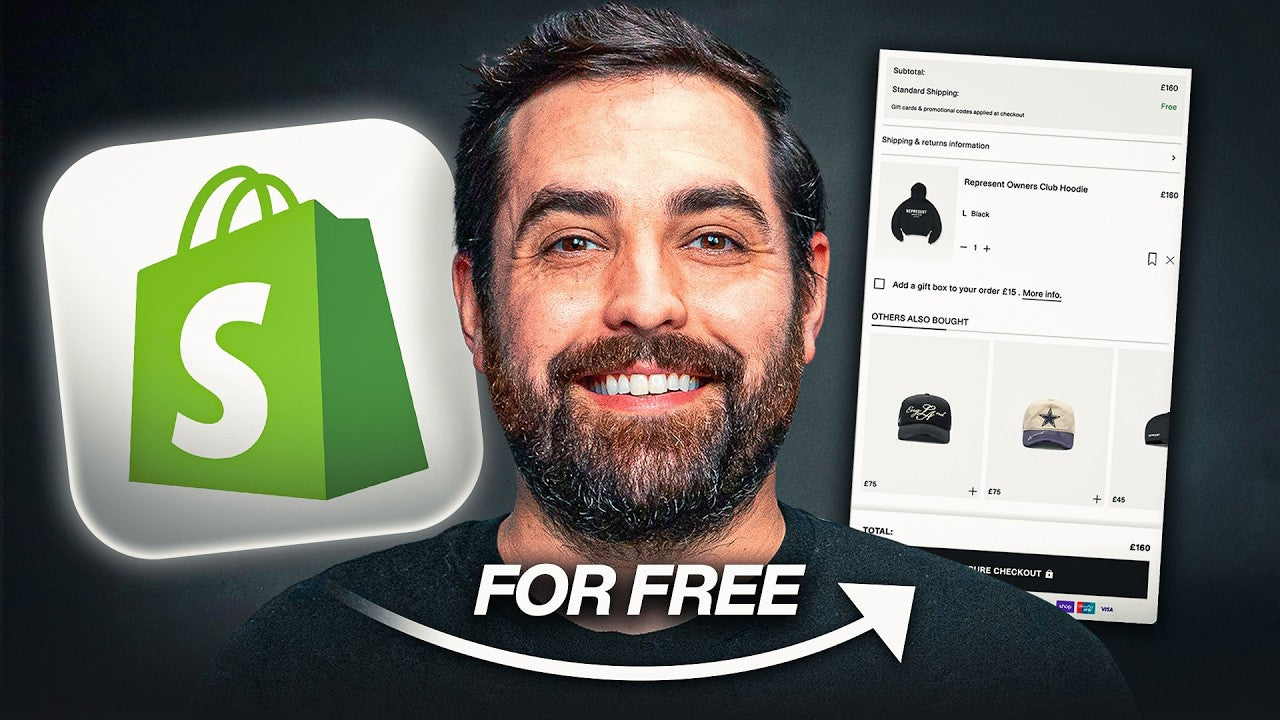
Premium Shopify brands like Represent Clothing look untouchable from the outside.
Luxury design. Seamless cart experiences. Clean checkout flows. Smart upsells. High average order values. Post-purchase optimization.
Most Shopify merchants assume these brands are winning because they are spending massive amounts on Shopify Plus, expensive developers, and enterprise software stacks.
But after analyzing Represent’s customer journey from add-to-cart to post-purchase, the reality becomes very clear:
The majority of what drives conversions can be recreated on Shopify Basic using smart UX decisions, lightweight apps, strategic Shopify configurations, and intentional customer journey design.
The real difference is not budget.
It is execution.
In this article, we’ll break down exactly how to rebuild Represent’s:
-
Cart drawer
-
Checkout experience
-
Thank-you page
-
Post-purchase system
using Shopify Basic and the Horizon theme while also modernizing the strategy using:
-
Shopify Metaobjects
-
Metafields
-
TikTok Shop
-
AI-driven personalization
-
Social commerce integrations
-
Customer behavior automation
-
Conversion-focused UX systems
We’ll also include implementation examples, performance insights, and tactical Shopify configurations you can apply immediately.
Why Most Shopify Stores Underperform

The biggest mistake most clothing brands make is focusing entirely on traffic acquisition while ignoring conversion architecture.
They obsess over:
-
Facebook ads
-
Google ads
-
Influencer campaigns
while their store experience leaks revenue everywhere.
Represent’s advantage is not simply Shopify Plus.
Their advantage is that every stage of the customer journey has intent behind it.
From:
-
The free shipping threshold
-
To trust signals
-
To simplified checkout
-
To post-purchase engagement
everything is engineered to reduce friction and increase order value.
That is what smaller Shopify brands need to replicate.
How to Grow a Clothing Brand Beyond Paid Advertising
Many entrepreneurs researching how to grow a clothing brand focus almost entirely on acquiring more traffic through Meta Ads, Google Ads, and influencer campaigns. While traffic is important, sustainable growth comes from combining acquisition with a strong clothing brand marketing strategy that prioritizes customer experience and conversion optimization.
The most successful Shopify Stores understand that growth happens when every stage of the buying journey is optimized. From product discovery and merchandising to checkout and post-purchase engagement, each interaction influences whether a visitor becomes a loyal customer. This is why Shopify conversion rate optimization should be treated as a core growth initiative rather than an afterthought.
Step 1: Rebuilding the Cart Drawer on Shopify Basic
The cart drawer is arguably the highest-leverage conversion asset on your entire store.
Why?
Because users opening the cart are already emotionally committed to buying.
This is the stage where:
-
Doubt appears
-
Hesitation happens
-
AOV decisions occur
Represent’s cart drawer includes:
-
Free shipping thresholds
-
Product recommendations
-
Shipping information
-
Payment trust signals
-
Secure checkout messaging
-
Minimal distractions
Each component serves a psychological purpose.
Technical Shopify Implementation: Free Shipping Thresholds
Instead of simply telling users:
“Add free shipping messaging,”
here’s how to implement it properly.
Shopify Execution Example
Option 1: Shopify Functions + Cart Transform Apps
If you are on Shopify Basic, apps like:
-
Corner Cart
-
Slide Cart Drawer
-
Essential Free Shipping Upsell
can dynamically calculate cart totals.
Option 2: Native Shopify Theme Logic
Inside your cart-drawer.liquid file:
{% assign free_shipping_threshold = 100 %}
{% assign current_total = cart.total_price | divided_by: 100 %}
{% if current_total < free_shipping_threshold %}
<p>You’re only ${{ free_shipping_threshold | minus: current_total }} away from free shipping.</p>
{% else %}
<p>You unlocked free shipping!</p>
{% endif %}
This creates dynamic threshold messaging without relying entirely on apps.
Why Dynamic Shipping Messaging Increases AOV

A static message saying:
“Free shipping over $100”
is weaker than dynamic progress messaging.
The psychological principle here is called goal-gradient behavior.
Customers become more motivated as they get closer to a reward.
Example:
-
Cart total: $82
-
Threshold: $100
Instead of abandoning, users often add:
-
Socks
-
Accessories
-
Hats
-
Basic tees
to “complete” the goal.
This is one reason premium clothing brands consistently achieve higher AOVs.
Before-and-After Cart Optimization Example

Before Optimization
Typical Shopify cart:
-
No free shipping incentive
-
No urgency
-
No trust indicators
-
Generic checkout button
-
No product recommendations
Result:
-
Lower checkout initiation rate
-
Lower AOV
-
Higher abandonment
After Optimization
Optimized cart drawer:
-
Dynamic shipping progress bar
-
Recommended add-ons
-
Secure checkout language
-
Payment icons
-
Shipping accordion
-
Sticky CTA
Result:
-
Higher checkout starts
-
Higher AOV
-
Better mobile conversion experience
Even small UX changes compound significantly at scale.
Why Shopify Conversion Rate Optimization Matters
Many merchants assume that increasing sales requires increasing advertising spend. In reality, Shopify conversion rate optimization often produces a higher return on investment than acquiring additional traffic. Small improvements to cart functionality, trust signals, product recommendations, and shipping transparency can significantly increase Shopify conversion rate without raising customer acquisition costs.
For growing Shopify Stores, conversion optimization allows brands to generate more revenue from existing traffic while improving the overall shopping experience. This creates a stronger foundation for long-term ecommerce growth.
Using Shopify Metafields for Product Upsells

Most stores manually assign upsells product by product.
That does not scale.
Instead, use Shopify Metafields.
Example Setup
Inside Shopify Admin:
Settings → Custom Data → Products
Create a metafield:
-
Namespace: custom
-
Key: related_products
-
Type: Product List
Now assign complementary products to each SKU.
Example:
-
Hoodie → Matching sweatpants
-
Oversized tee → Layering flannel
-
Cargo pants → Belt accessory
Then pull those dynamically into the cart drawer.
Shopify Liquid Example for Dynamic Upsells
{% for product in cart.items %}
{% assign related = product.product.metafields.custom.related_products.value %}
{% for related_product in related %}
<div class="upsell-product">
<a href="{{ related_product.url }}">
{{ related_product.title }}
</a>
</div>
{% endfor %}
{% endfor %}
This creates scalable contextual upsells based on customer intent.
Why Contextual Upsells Outperform Generic Recommendations
Most Shopify stores use random “You May Also Like” carousels.
Represent’s cart strategy works because recommendations are contextually relevant.
Relevant upsells:
-
Increase conversion rates
-
Improve AOV
-
Feel helpful instead of pushy
A hoodie recommendation beside a hoodie purchase performs far better than random unrelated products.
Using Shopify Metaobjects for Reusable Benefit Stacks
Instead of manually rewriting:
-
Shipping details
-
Fabric descriptions
-
Fit notes
-
Care instructions
for every SKU, use Shopify Metaobjects.
Example Metaobject Structure
Create a Metaobject called:
“Garment Features”
Fields:
-
Fabric composition
-
Fit type
-
Washing instructions
-
Shipping timeline
-
Returns policy
Now assign that metaobject to multiple products.
This reduces:
-
Manual editing
-
Inconsistency
-
Content duplication
while improving scalability.
Shopify Theme Integration Example
Inside product templates:
{{ product.metafields.custom.garment_features.value.fabric }}
This lets one update apply across dozens of SKUs instantly.
Enterprise brands use systems like this constantly.
Trust Signals That Actually Improve Shopify Conversion Rates

Represent uses:
-
Secure checkout language
-
Payment icons
-
Clean hierarchy
-
Minimal distractions
But let’s modernize this strategy.
Add:
-
Estimated delivery dates
-
Klarna badges
-
Returns guarantees
-
Authenticity messaging
-
UGC near checkout
Visual Evidence: UGC Near Checkout
One of the biggest ecommerce shifts in 2026 is placing creator content closer to conversion moments.
Instead of generic trust badges alone:
embed:
-
TikTok reviews
-
Instagram UGC
-
Customer try-on videos
inside:
-
Product pages
-
Cart drawers
-
Thank-you pages
Apps like:
-
Tolstoy
-
Videowise
-
Firework
make this possible directly inside Shopify.
Why Social Commerce Is Reshaping Shopify Conversion Strategy

Traffic is no longer coming exclusively from:
-
Google
-
Meta
Now it increasingly comes from:
-
TikTok Shop
-
Instagram Shops
-
YouTube Shopping
-
Pinterest Product Pins
The buying journey has fragmented.
Your Shopify store now functions as:
-
Brand hub
-
Conversion engine
-
Retention platform
not merely a storefront.
TikTok Shop + Shopify Integration Strategy
Clothing brands should integrate TikTok Shop directly with Shopify inventory.
Benefits
-
Native checkout inside TikTok
-
Product tagging in creator videos
-
Sync inventory automatically
-
Lower friction purchasing
Technical Setup
Inside Shopify:
Apps → TikTok
Enable:
-
Product sync
-
Pixel integration
-
Catalog management
Now creators can directly tag products in videos.
This shortens the path from discovery to purchase dramatically.
AI Personalization Is Becoming Essential
Modern Shopify brands increasingly use AI-driven personalization.
Not generic personalization.
Behavior-based personalization.
AI Cart Recommendations Example
Apps like:
-
LimeSpot
-
Rebuy
-
Searchspring
analyze:
-
Cart contents
-
Browsing behavior
-
Purchase history
-
Customer cohorts
to generate smarter recommendations.
Example:
Customer behavior:
-
Viewed oversized streetwear
-
Added black hoodie
-
Browsed cargos
AI recommends:
-
Oversized cargos
-
Matching beanie
-
Heavyweight tee bundle
instead of random unrelated products.
This dramatically improves:
-
Relevance
-
AOV
-
Conversion quality
The Rise of AI Ecommerce Personalization
AI ecommerce personalization is transforming how modern clothing brands engage customers online. Instead of presenting identical product recommendations to every visitor, AI-driven systems analyze browsing behavior, shopping preferences, and purchase history to create more relevant shopping experiences.
For brands evaluating how to grow a clothing brand in an increasingly competitive market, AI ecommerce personalization offers a powerful advantage. Personalized product recommendations, dynamic merchandising, and behavior-based customer journeys help improve engagement, increase average order value, and strengthen customer retention.
Checkout Optimization on Shopify Basic
Shopify Basic still limits:
-
Checkout extensibility
-
Custom fields
-
One-click upsells
But most brands are underutilizing what they already have access to.
Shopify Basic vs Shopify Plus for Growing Clothing Brands
The debate around Shopify Basic vs Shopify Plus often leads merchants to believe that upgrading platforms automatically increases revenue. However, many high-impact improvements can be implemented successfully on Shopify Basic without enterprise-level costs.
When comparing Shopify Basic vs Shopify Plus, brands should focus on business requirements rather than platform prestige. Effective Shopify checkout optimization, mobile payment options, streamlined shipping configurations, and trust-building design elements can help increase Shopify conversion rate regardless of the plan being used.
Shopify Checkout Branding Execution
Inside:
Settings → Checkout → Customize
Configure:
-
Brand logo
-
Typography
-
Button styling
-
Accent colors
-
White backgrounds
-
Consistent spacing
Represent uses extremely minimal branding with strong contrast.
This matters because inconsistent checkout styling destroys trust.
Shop Pay and Accelerated Mobile Checkout
Shop Pay is one of the most underrated conversion tools on Shopify.
Mobile users hate:
-
Typing addresses
-
Entering card numbers
-
Multi-step forms
Shop Pay removes this friction.
Enable:
-
Shop Pay
-
Apple Pay
-
Google Pay
-
PayPal Express
inside:
Settings → Payments
Modern Shopify Checkout Optimization Strategies
Successful Shopify checkout optimization focuses on removing friction and simplifying the purchasing process. Customers increasingly expect fast, mobile-friendly experiences that allow them to complete purchases with minimal effort.
Features such as Shop Pay, Apple Pay, Google Pay, and streamlined checkout flows reduce abandonment while helping increase Shopify conversion rate. As mobile commerce continues to grow, optimizing the checkout experience has become one of the most important priorities for Shopify Stores seeking higher conversion performance.
Modern Payment Layer Strategy
In 2026, installment purchasing is expected.
Customers increasingly expect:
-
Klarna
-
Afterpay
-
Shop Pay Installments
especially in apparel.
Represent supports installment-friendly structures because it reduces price resistance.
Example:
A $240 hoodie psychologically feels smaller as:
“4 payments of $60.”
That framing increases conversions.
Shipping Configuration That Reduces Abandonment

Represent simplifies shipping into:
-
Standard
-
Express
Most Shopify stores overwhelm customers with unnecessary options.
Shopify Shipping Setup Example
Inside:
Settings → Shipping and Delivery
Create:
Standard Shipping
-
Free over $100
Express Shipping
-
Flat rate: $20
-
Delivery estimate: 1–3 days
Remove:
-
Redundant carrier options
-
Confusing calculations
-
Excessive variations
This reduces decision fatigue.
The Thank-You Page Is a Massive Missed Opportunity
The thank-you page has unusually high engagement because customers are:
-
Emotionally validated
-
Excited
-
Paying attention
Most brands waste this completely.
Represent at least adds:
-
Order editing
-
Customer surveys
But modern brands should go further.
High-Converting Post-Purchase Systems
Modern thank-you pages should include:
-
Cross-sells
-
Loyalty invitations
-
Referral offers
-
TikTok follow prompts
-
SMS opt-ins
-
Creator content
-
Educational onboarding
Example Post-Purchase Flow
Immediately After Purchase
Offer:
“Add matching shorts within 10 minutes for free shipping.”
Then:
Invite customer to:
-
Join SMS list
-
Follow TikTok
-
Unlock loyalty rewards
Then:
Display:
-
Customer UGC
-
Style inspiration
-
Care guides
This extends customer engagement beyond the transaction.
Triple Whale Post-Purchase Surveys
Triple Whale allows brands to collect:
-
Attribution insights
-
Customer feedback
-
Marketing source data
This is increasingly important because:
-
iOS attribution is imperfect
-
TikTok attribution is fragmented
-
Multi-touch journeys are harder to track
Post-purchase surveys often reveal the real conversion source.
Real Shopify Growth in 2026 Requires Omnichannel Thinking
The old ecommerce model:
-
Run Facebook ads
-
Send traffic to Shopify
-
Hope for conversions
is fading.
Modern clothing brands grow through:
-
Creator ecosystems
-
TikTok Shop
-
UGC loops
-
AI personalization
-
Community commerce
-
SMS retention
-
Social shopping experiences
Your Shopify store is now just one part of the ecosystem.
Building a Modern Clothing Brand Marketing Strategy
A successful clothing brand marketing strategy extends beyond paid advertising and social media campaigns. Modern apparel brands must create connected customer experiences across multiple channels, including TikTok Shop, email marketing, SMS campaigns, creator partnerships, and their Shopify storefront.
Brands looking to understand how to grow a clothing brand should focus on building an ecosystem that combines content, community, retention, and conversion optimization. The strongest Shopify Stores create seamless experiences across every touchpoint while using AI ecommerce personalization and customer behavior data to deliver more relevant interactions.
The Biggest Lesson From Represent’s Store

Represent is not converting because of “secret” technology.
They are converting because:
-
Their cart is intentional
-
Their checkout is clean
-
Their shipping is simple
-
Their trust signals are strong
-
Their customer journey is thoughtful
That level of intentionality matters more than expensive software.
Why Brands Invest in Shopify Optimization Services
As ecommerce competition continues to increase, many brands are turning to Shopify optimization services to improve customer experience and maximize revenue. Rather than focusing solely on traffic acquisition, optimization services help businesses identify conversion barriers, improve site performance, and create more effective customer journeys.
From Shopify conversion rate optimization and Shopify checkout optimization to AI ecommerce personalization and post-purchase retention systems, optimization initiatives help Shopify Stores generate stronger results from existing traffic.
Final Thoughts
You do not need Shopify Plus to build a premium ecommerce experience.
You need:
-
Better execution
-
Better customer psychology
-
Better UX systems
-
Better merchandising
-
Better post-purchase strategy
The brands winning in 2026 are not merely running ads.
They are building ecosystems:
-
Social commerce
-
AI-driven personalization
-
Creator-led acquisition
-
Retention-first customer journeys
And the good news is that Shopify Basic is now powerful enough to support much of this strategy affordably.
The gap between small brands and enterprise brands has never been smaller.
Execution is now the differentiator.
Need Help Optimizing Your Shopify Store?

If you're searching for Shopify optimization services or looking for an ecommerce marketing agency near me that understands apparel ecommerce, our team specializes in helping clothing brands improve performance through Shopify conversion rate optimization, Shopify checkout optimization, AI ecommerce personalization, and customer journey improvements designed to increase Shopify conversion rate and drive sustainable growth.
If you want help improving your:
-
Shopify conversion rate
-
Cart drawer UX
-
Checkout flow
-
Clothing brand funnel
-
TikTok Shop integration
-
AI personalization systems
-
Post-purchase retention
-
AOV strategy




Share:
How to Run Facebook Ads for Clothing Brands Using Claude
How to Improve Your Shopify Conversion Rate Using Microsoft Clarity and Claude