

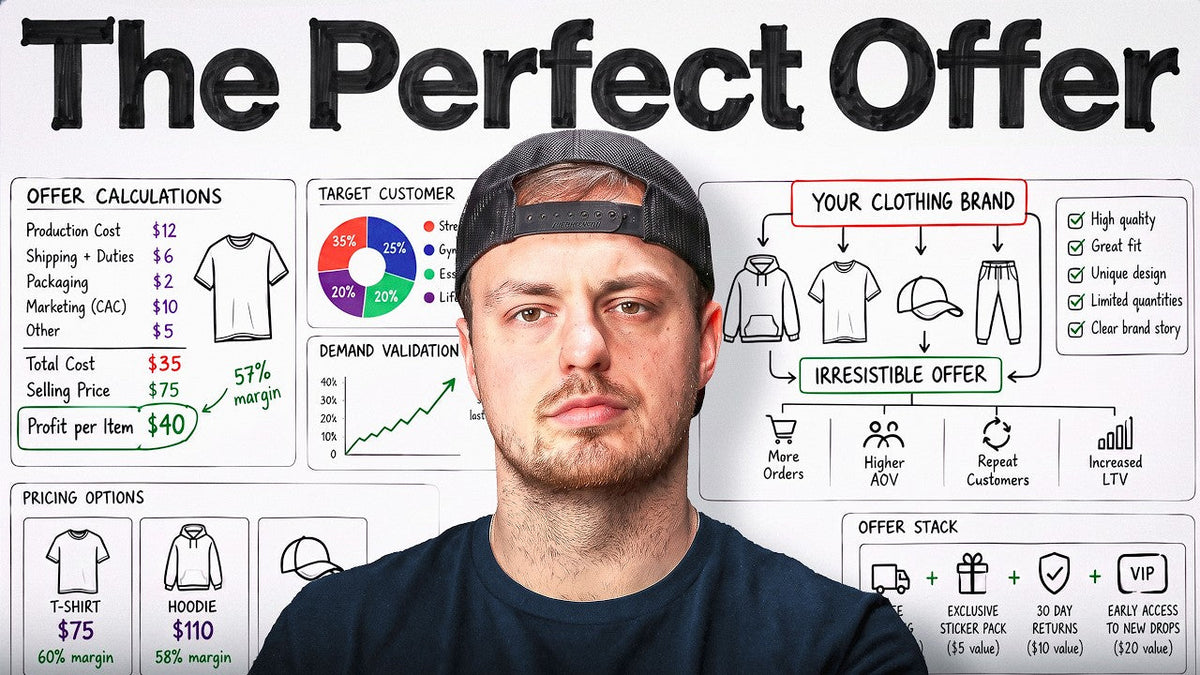
Most clothing brands decide on an offer backwards.
They start with the discount.
“Should we do 15% off?”
“Maybe 20%?”
“It’s Black Friday. Should we just do 25% off everything?”
That’s usually the wrong question.
The question I want you to ask is:
Will this offer actually make us money?
Because an offer can generate a ton of orders and still leave you wondering where all the profit went.
I see this constantly with clothing brands. Founders focus on revenue, conversion rate, or how generous the offer looks without running the numbers behind it.
So I want to show you a better way.
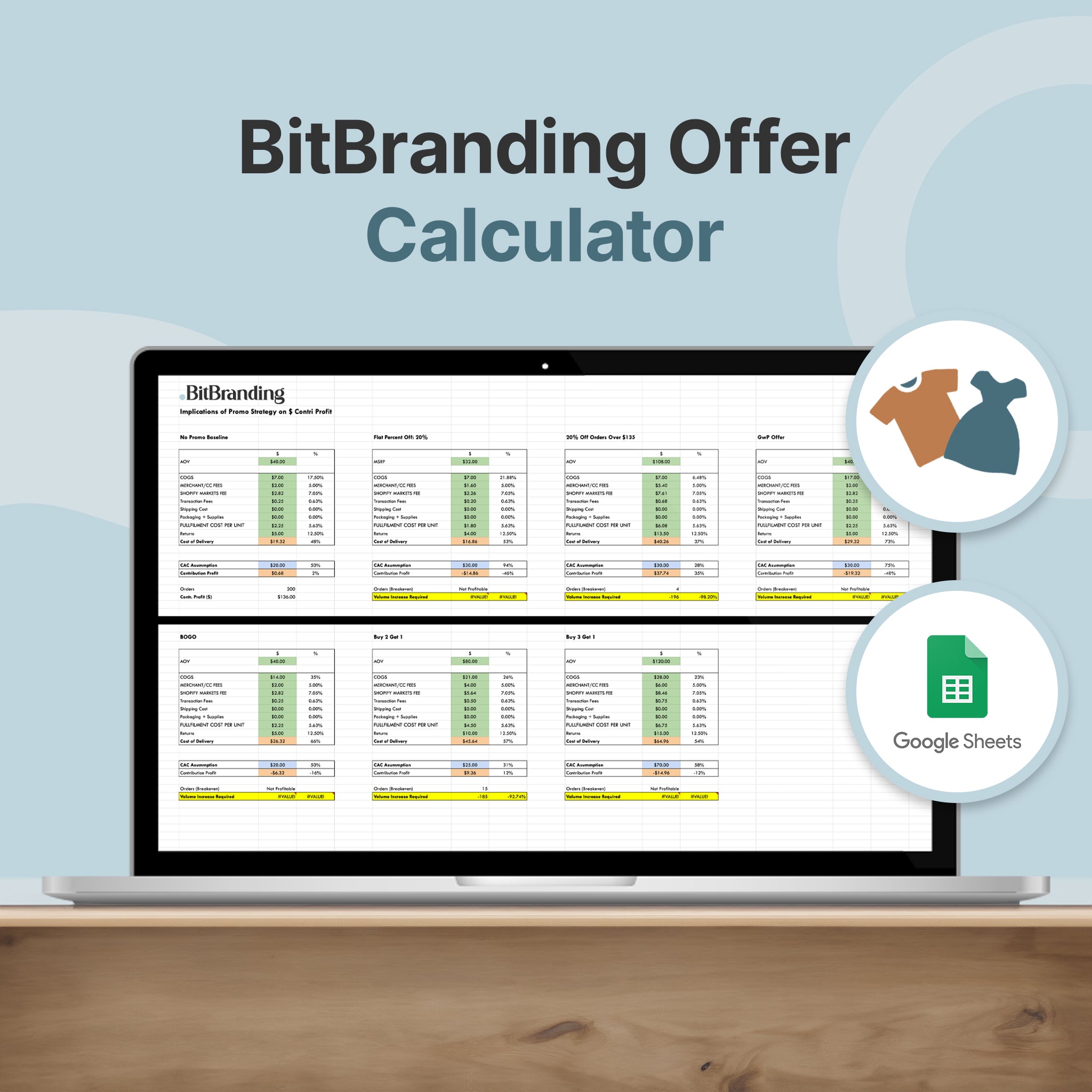
I’m going to use a real clothing brand we work with as an example. The brand is doing around $50,000 per month, and we ran its numbers through our Offer Optimizer to see what happens when you compare different offers.
The results are a good reminder that the biggest discount is rarely the smartest offer.
What Makes a Clothing Brand Offer Profitable?

Before I decide whether an offer is good, I want to know the economics behind the store.
At a minimum, I’m looking at:
-
Average order value (AOV)
-
Cost of goods sold (COGS)
-
Fulfillment cost
-
Payment processing fees
-
Return rate
-
Customer acquisition cost (CAC)
-
Customer lifetime value (LTV)
-
Affiliate or creator commissions
-
Cost of any free products or gifts included in the offer
This is where a lot of brands get into trouble.
They know their revenue.
They know their ad spend.
But they don’t necessarily know what happens to the money between the sale and the bottom line.
A Real Clothing Brand Example
For the brand we audited, the numbers looked roughly like this:
Monthly revenue: $50,000
Average order value: $45–$50
COGS: around 20–25%
Fulfillment: relatively low
Return rate: under 5%
Customer lifetime value: approximately $150
Paid acquisition cost: roughly $25–$26
Those numbers immediately give me something useful.
If the average customer is worth around $150 over their relationship with the brand, I don't necessarily need to make a huge profit on the first order.
But I still need to know what I'm paying to acquire that customer.
That's where the offer comes in.
Your Discount Is Part of Your Acquisition Cost
This is one of the biggest mindset shifts I want clothing brand owners to make.
A discount isn't just a discount.
It's a customer acquisition expense.
Imagine I normally acquire a customer for $25 through paid advertising.
Now I introduce an offer that costs me another $10 per order.
My effective acquisition cost isn't really $25 anymore.
It's closer to $35.
That might still be a great deal if the customer is worth $150.
But what happens if I give away $15, pay an affiliate commission, cover a free product and watch my paid acquisition cost jump during Black Friday?
Suddenly that “amazing” offer isn't so amazing.
That's why I don't choose offers based on what competitors are doing.
I run the math first.
The Biggest Offer Mistake I See Clothing Brands Make
Here it is:
20% off everything.
Or 25%.
Or 30%.
Pick your number.
Black Friday comes around and everyone starts discounting, so clothing brands assume they have to do the same thing.
But there's nothing magical about 20% off.
Your customer doesn't know whether 20% is profitable for you.
Neither does your competitor.
You need to calculate it using your own margins.
In the example above, we modeled a standard sitewide Black Friday offer.
At around 20% off, the economics started getting tight once paid acquisition was included.
At 25% off, the model became unprofitable under the assumptions we entered.
That's the danger.
You can have your biggest sales weekend of the year and still create a profit problem.
An Offer Is More Than a Discount
This is where things get interesting.
When I say “offer,” I don't automatically mean “percentage off.”
An offer is simply the reason someone should buy now instead of later.
That could be:
-
A gift with purchase
-
A spending threshold
-
A bundle
-
Buy one, get one
-
Exclusive access
-
A digital bonus
-
A styling guide
-
A limited-edition product
-
Free personalization
-
A loyalty reward
-
An ambassador program
-
A gift card incentive
-
An extended return period
Sometimes the best offer doesn't require reducing the price of the main product at all.
A Real Example: Turning Athletes Into the Offer

One of the most interesting things about the brand we analyzed was its athlete program.
Instead of simply saying:
“Here's 20% off.”
The brand built something bigger around the customer and community.
Athletes can participate in the program, receive referral links and discount codes, earn revenue from sales, build their profiles and contribute feedback that helps influence future products.
There's also an athlete fund where a portion of sales and sponsor contributions can be distributed among qualifying athletes.
Think about what happened there.
The brand didn't just create a discount.
It created:
Community + participation + earning potential + identity + product influence.
That's an offer.
And it gives people a reason to care about the brand beyond saving a few dollars.
You don't need to build an athlete program to use this idea.
The lesson is simpler:
What does your audience value that you can attach to the purchase without destroying your margins?
Start With Customer Lifetime Value
If there's one number I want you to understand before building an aggressive acquisition offer, it's customer lifetime value.
For our example brand, estimated LTV was around $150.
That changes how I look at the first purchase.
If I can acquire a customer profitably relative to what that customer is expected to contribute over time, I can potentially afford a stronger acquisition offer.
But be careful here.
Don't use an inflated LTV number to justify bad first-order economics.
Look at your actual Shopify customer data.
Ask:
How much does the average new customer spend over 90 days? Six months? Twelve months?
Then segment it.
A customer acquired through a 30% discount may behave differently from someone acquired at full price.
That matters.
The objective isn't just acquiring customers.
It's acquiring valuable customers.
Use Shopify Data Instead of Guessing
This is where modern Shopify stores have a major advantage.
You have access to much more data than most founders actually use.
Start by tracking the economics of each offer:
Offer revenue – COGS – discount – fulfillment – transaction costs – affiliate commission – acquisition cost = contribution profit
Then compare offers.
Don't simply ask which campaign generated the most revenue.
Ask:
Which campaign generated the most contribution profit and the best customers?
Shopify's current AI tooling can also help make analysis faster. Sidekick works within the context of a merchant's store and can assist with data analysis and other administrative tasks, while Shopify Magic provides AI functionality across areas such as content, media and store workflows.
The tools are getting better.
But they don't change the fundamental question:
Does the math work?
How I'd Structure Offer Data Inside Shopify
If you're testing offers regularly, don't bury everything inside product descriptions.
Build some structure around it.
For example, Shopify Metafields can hold product-level information such as:
Material: 100% heavyweight cotton
Fit: Oversized
Use case: Training/lifestyle
Bonus: Free training guide
Offer eligibility: Holiday bundle
If the same information needs to be reused across many products, you can structure reusable content instead of manually rebuilding it SKU by SKU.
That makes it much easier to create consistent product pages, landing pages and campaigns.
For an apparel store with hundreds of variants, this matters.
Your marketing shouldn't require someone to manually rewrite the same information every time you launch an offer.
Offer Strategy #1: Gift With Purchase
This is one of my favorite options because the perceived value of a gift can be much higher than your actual cost.
Let's say you sell a $50 shirt.
Instead of offering:
20% off = $10 revenue sacrificed
you could offer:
Spend $50 and get a free accessory worth $15.
Maybe that accessory costs you $4–$5 landed.
The customer sees $15 in additional value.
You spend $5 instead of giving away $10.
That's the type of math I like.
Even better, choose a gift that introduces customers to another product category.
Now your promotion can potentially create the next purchase as well.

Caption:
The customer can perceive similar or greater value while the brand protects more contribution margin.
Offer Strategy #2: Use Thresholds to Increase AOV
Instead of:
20% off everything
try:
20% off orders over $75.
Now the customer has to increase their cart value to unlock the deal.
This is especially useful when your normal AOV is around $45–$50.
If someone has $52 in their cart and needs $75 to unlock the offer, you've given them a reason to add another product.
That's much different from automatically discounting the $52 order they were already going to place.
The principle is simple:
Make customers do something valuable for the business to unlock the incentive.
Spend more.
Buy multiple items.
Join your loyalty program.
Refer someone.
Purchase a particular bundle.
That is what I mean by changing the shape of the offer.
Offer Strategy #3: Build Bundles Around Natural Product Pairings
Clothing brands have a huge opportunity with bundles.
Think:
T-shirt + hat
Hoodie + joggers
Training shirt + shorts
Dress + accessory
Three tees for $X
Instead of discounting every individual product, create a higher-value purchase.
Let's say:
One shirt = $40
Two shirts = $80
Rather than offering 25% off the first shirt, you might create an incentive for buying two.
You give up some margin, but you increase units per transaction and potentially AOV.
The exact numbers depend on your COGS, shipping and acquisition costs.
Again, run the math.
Offer Strategy #4: Add a Digital Bonus
Digital bonuses are underused in apparel.
They can have high perceived value with almost zero marginal fulfillment cost.
For an athletic brand, that could be:
A four-week training plan.
For a men's fashion brand:
A simple guide to building five outfits from ten pieces.
For a women's boutique:
A seasonal styling guide.
For a streetwear brand:
Early access to limited drops.
You're adding a reason to buy without automatically reducing the product price.
That's exactly what I want.
Offer Strategy #5: Don't Ignore Gift Cards
Gift cards can be especially useful around holidays, anniversaries and gifting periods.
They solve a real customer problem:
“I know they'll like this brand. I just don't know which product, color or size to buy.”
Shopify also supports discounts on gift-card products, including fixed or percentage discounts and Buy X Get Y structures involving gift cards.
That creates some interesting possibilities.
For example:
Spend $100, get a $10 gift card for your next purchase.
Now you're not simply discounting today's transaction.
You're creating a reason for another visit.
Just make sure you model the future redemption liability properly. A gift card isn't free money simply because it hasn't been redeemed yet.
Your Offer Has to Work Beyond Meta and Google
This is another area where clothing brand strategy has changed.
Your offer shouldn't only make sense inside a Facebook ad.
Today, that same offer might appear across:
-
Meta
-
Google and YouTube
-
Email
-
SMS
-
Influencer content
-
Affiliate links
-
Organic short-form video
-
TikTok
-
TikTok Shop
-
Instagram shopping
-
Live shopping
Shopify's current social-commerce channels can connect merchants with Facebook and Instagram, TikTok Shop and other commerce experiences. TikTok Shop can support shoppable in-feed video, LIVE shopping and product showcases, with eligible merchants able to sync products and manage orders through Shopify. Availability depends on the merchant's market.
That changes how I think about offers.
An offer needs to be easy to understand in seconds.
If a creator has to spend two minutes explaining your promotion, you've probably made it too complicated.
“Buy two, save 20%.”
“Spend $75, get the limited-edition hat free.”
“Join the drop and get early access.”
Those travel well across channels.
Creator and Affiliate Offers Need Different Math
This was important in the brand we analyzed.
There are two completely different situations.
Scenario one: The athlete or creator posts the product to their existing audience.
Scenario two: The brand puts paid media behind that creator content.
Those aren't the same acquisition model.
If you're paying:
20% customer discount + 10% creator commission + paid media CAC
you need to calculate all three.
Otherwise, an affiliate campaign that looks successful in your dashboard may be quietly eating your margin.
Track each creator with a unique link or discount code.
Then look beyond attributed revenue.
Measure:
Orders → AOV → discount cost → commission → CAC → new-customer rate → repeat purchase rate → contribution margin.
That's how you find creators who actually make the business money.
Use AI to Analyze Offers, Not Invent Your Economics

I'm a big believer in using AI to make this process faster.
That's essentially what our Offer Optimizer does.
But I don't want AI deciding that “20% off sounds good.”
I want it to interview me.
What is your AOV?
What is your COGS?
What are your fulfillment costs?
What is your return rate?
What's your CAC?
What's your LTV?
What's the creator commission?
What's the cost of the gift?
How many units do you expect to sell?
Then run different scenarios.
Shopify itself has moved further in this direction. Sidekick can analyze store context and assist with tasks using natural-language requests, and Shopify says its newer Sidekick capabilities include proactive recommendations and custom app generation.
AI should help you ask better questions and process the data faster.
It shouldn't replace the numbers.
Test Offers Like Experiments
I wouldn't launch one offer and immediately declare it the winner.
Test it.
For example:
Offer A: 20% off everything
Offer B: Spend $75, get 20% off
Offer C: Spend $75, get a free $15 gift
Offer D: Buy two, save 20%
Offer E: Full price + exclusive digital bonus
Now measure more than conversion rate.
Look at:
Conversion rate
Average order value
Units per transaction
CAC
Contribution margin
New customer percentage
Repeat purchase rate
Return rate
An offer that converts at 5% isn't automatically better than one converting at 4%.
If the second offer produces a higher AOV, better margin and higher-quality customers, I'd rather have the second offer.

The Black Friday Offer I Would Avoid
If you're heading into Black Friday, Cyber Monday, an anniversary sale or another major promotion, don't automatically choose:
25% off sitewide.
Run it through your economics first.
Ask yourself:
What happens to margin?
What happens if CAC increases?
Can I increase AOV instead?
Could a gift cost less than the discount?
Could I create a bundle?
Could I gate the offer behind a spending threshold?
Could I add something digital?
Could I create exclusivity instead of lowering the price?
You may still decide that 25% off makes sense.
Fine.
At least now it's a business decision instead of a guess.
The Clothing Brand Offer Formula I Use
When I'm working through this with a brand, I simplify it down to five steps.
1. Know the customer.
What do they actually value?
2. Know the economics.
AOV, COGS, fulfillment, CAC, LTV, returns and commissions.
3. Create additional value before reducing the price.
Think gifts, bundles, access, community, content and exclusivity.
4. Gate the incentive whenever possible.
Make the customer increase AOV, buy multiple products or take another valuable action to unlock it.
5. Measure contribution profit, not just revenue.
That's the part that tells you whether the promotion actually worked.
A Bigger Discount Isn't a Better Offer
This is the main thing I want you to take away from this.
The size of the discount matters less than the structure of the offer.
If you're selling a $50 shirt and immediately knock $12.50 off it, you've given away $12.50.
If instead you can get that customer to spend $75 to receive something that costs you $5, you've created a completely different economic outcome.
That's offer strategy.
And it's how I want clothing brands thinking.
Don't ask:
“How much should we discount?”
Ask:
“What can we give this customer that they genuinely want, while making the transaction more valuable for both of us?”
Answer that question and you stop competing only on price.
Want Me to Run the Numbers With You?

If you're running a clothing brand and trying to scale toward $100K months, your next offer shouldn't be based on what another brand is doing.
It should be built around your customers, your margins and your numbers.
We've worked with hundreds of clothing brands, and this is exactly the type of strategy we work through with owners who want to grow without blindly sacrificing margin.
If you'd like us to look at your brand, your numbers and the offers you're currently running, schedule a free strategy session with us.
Schedule Your Free Strategy Session
We'll look at where you are now, what may be holding back growth and what you can change to build offers that don't just generate sales.
They generate profitable growth.



Share:
Run-up Strategy Offer Planning Budget Scaling Creative Testing Website Structure
Why Your $68 Shirt Feels Overpriced (It's Not the Shirt)