

Somebody reading this article is probably about to waste $10,000 on a strategy that sounds smart but does absolutely nothing for their clothing brand.
I've seen it happen more times than I can count.
Over the last 12 months, we've worked with more than 300 clothing brand owners. And one thing I've noticed is that many of them are following the same bad advice.
They're spending money on ads that don't convert. Launching new collections before their existing products have proven themselves. Hiring agencies that promise results but deliver very little.
And sometimes, they're doing everything they've been told to do but still can't figure out why their brand isn't growing.
Here's the problem.
Not all growth advice is good advice. And some of the most popular strategies are the ones costing clothing brands the most money.
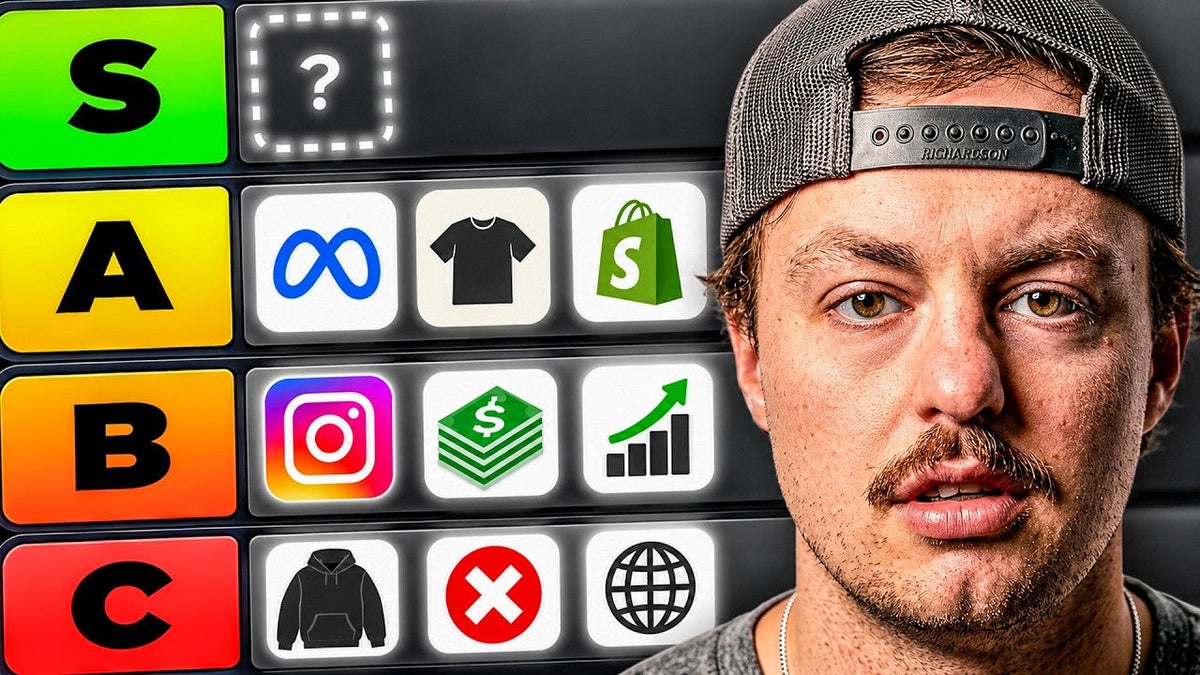
So I'm ranking 13 common pieces of advice for scaling a clothing brand, from S-tier (the best) all the way down to F-tier (the worst).
I'll also explain how I'd actually put the good strategies into practice using Shopify, Meta ads, content marketing, and the tools available to clothing brands today.
Because growing a clothing brand isn't about doing more.
It's about doing more of what works.
The Clothing Brand Growth Strategy Tier List
Here's how I'd rank all 13 strategies based on what we've seen working with clothing brands.
|
Strategy |
Grade |
|---|---|
|
Product development over chasing trends |
S |
|
One Meta campaign, broad targeting, diverse creative |
S |
|
Ambassador and UGC funnels |
A |
|
Posting three times a day |
A |
|
Pre-selling inventory |
B |
|
Using AI in your business |
B |
|
Premium product photography |
B |
|
ABO and bid cap campaigns |
C |
|
Commission-only agencies |
C |
|
Opening a physical store too early |
D |
|
Limited drops as your primary strategy |
D |
|
Testing hundreds of POD designs on small budgets |
F |
|
Trying to sell to everyone |
F |
These grades aren't universal rules. They're how I'd prioritize these strategies for most growing clothing brands, especially those trying to build a profitable ecommerce business.

Design note: Create a branded tier-list graphic using the 13 strategies and grades above. This would work well near the beginning of the article and as a standalone social media post.
F-Tier: The Worst Advice for Scaling a Clothing Brand
1. Create Hundreds of Print-on-Demand Designs and Test Them With Small Ad Budgets
I understand why people recommend this.
Create hundreds of designs, spend a little money advertising each one, and let the data tell you which products people want.
Sounds logical, right?
Except that's not really how you build a brand.
When you spread a small advertising budget across hundreds of designs, you're giving each product very little opportunity to prove itself.
Let's say you have $1,000 to spend on Meta ads and 100 different designs.
That's just $10 per design.
What are you realistically going to learn from that?
Not much.
And even if one design generates a few sales, that doesn't necessarily mean you've discovered a product you can scale profitably.
You're testing products without building the brand behind them.
My advice: Stop trying to sell hundreds of products. Start building a brand people actually want to buy from.
Here's what I'd do instead:
-
Identify one clear customer audience.
-
Develop three to five products that genuinely fit that audience.
-
Choose your strongest product as the potential hero product.
-
Build advertising creative around different reasons someone would want it.
-
Measure profitability and customer response before expanding.
On Shopify, you can use product-level sales reports, conversion data, and inventory performance to see which products deserve more attention.
And when testing Meta ads, don't confuse having lots of designs with having lots of meaningful creative angles.
You might test the same shirt using a customer testimonial, a product demonstration, a lifestyle video, and a comparison against an alternative.
That's a much more useful test than advertising 100 unrelated designs with almost no budget behind them.
My grade: F-tier.
2. Try to Sell Your Clothing to Everyone
This is another one I hear constantly.
"Aaron, I want to sell to men, women, kids, grandparents, and maybe even pets."
I get it. More potential customers should mean more sales.
But it usually doesn't work that way.
When you try to appeal to everyone, your marketing becomes so generic that nobody feels like your brand was created for them.
Think about the difference between these two messages.
Generic: "High-quality clothing for everyone."
Specific: "Performance fishing shirts built for long days on the water."
The second message immediately tells the right customer that the product is for them.
That's powerful.
And it doesn't mean other people can't buy your products. It means your marketing has a clear direction.
How I'd fix this on Shopify
Start by defining your core customer and then make sure your store communicates that positioning.
Your homepage headline, product photography, collections, product descriptions, and advertising should all speak to the same customer.
For example, a premium coastal clothing brand could build collections around boating, fishing, and casual waterfront living rather than trying to become a general clothing store.
You can also use Shopify customer segments to understand which groups purchase most frequently and which generate the highest customer value.
The goal isn't to exclude everyone else.
It's to make the right customers feel like they've found exactly what they're looking for.
My grade: F-tier.
D-Tier: Strategies That Can Create Expensive Problems
3. Open a Physical Store Before Your Brand Is Ready
I love the idea of combining online and offline retail.
There are some fantastic clothing brands doing both.
But opening a physical location during your first couple of years can be an incredibly expensive mistake.
Suddenly, you've got rent, staff, utilities, fixtures, insurance, and inventory sitting on shelves.
And those expenses don't disappear just because sales are slow.
If you haven't proven that people consistently want your products, you're making a huge financial commitment without enough information to justify it.
I'd rather see a clothing brand establish consistent online demand before taking on that kind of fixed cost.
A better way to test physical retail

Before signing a long-term lease, consider testing demand through pop-up shops, markets, or temporary retail partnerships.
If you're using Shopify, Shopify POS can help connect eligible in-person transactions with your online product catalog, inventory, and customer records.
That gives you a clearer picture of whether physical retail is actually adding profitable sales.
Track the total cost of each event, revenue, gross profit, and whether customers come back to purchase online.
If the numbers support expansion, great.
But don't open a store just because you've always dreamed of having one.
My grade: D-tier.
4. Build Your Entire Business Around Limited Clothing Drops
Limited drops can work extremely well.
We've all seen brands create massive demand around a product launch.
But here's what people don't talk about enough.
What happens when your drop performs okay, but not great?
You've spent money developing the collection, ordering inventory, producing content, and promoting the launch.
Now you need money for the next collection.
And if the first one didn't generate enough profit, you're stuck.
I recently spoke with an Australian clothing brand owner who had been operating for about two years.
They had lots of different products and were constantly launching new collections.
But when we looked closer, there were about three products that were performing significantly better than everything else.
We discussed how focusing inventory and marketing on those proven winners could potentially create a business generating around $400,000 annually, rather than constantly funding new launches.
That was an opportunity estimate, not an achieved result.
The lesson was simple.
You don't always need another collection. Sometimes you need to sell more of what already works.
Here's how I think about it:
-
Hero products are often your best opportunity to acquire new customers.
-
New drops can give existing customers another reason to buy.
-
Evergreen products create more predictable revenue.
-
Limited releases work best when there's already enough audience demand.
On Shopify, I'd look at sales by product, sell-through rates, inventory turnover, and repeat customer behavior before committing to another collection.
And I'd make sure there's enough cash left after the launch to fund the next stage of growth.
My grade: D-tier.
C-Tier: Strategies That Can Work, but Have Better Alternatives
5. Run ABO and Bid Cap Meta Ad Campaigns
Let's talk about Meta ads.
ABO stands for Ad Set Budget Optimization. It means you're assigning budgets at the ad set level instead of letting the campaign distribute the budget across ad sets.

Bid caps are another way of controlling advertising delivery by setting a maximum bid in Meta's auction.
Neither tool is inherently bad.
I've seen advertisers use them successfully.
But for most clothing brands, especially those working with limited budgets, they can introduce unnecessary restrictions.
If you're forcing spending into separate ad sets, you may be allocating money to audiences that aren't delivering results.
And if your bid cap is too restrictive, your ads may struggle to deliver at all.
Meta's advertising system uses signals such as estimated action rates and ad quality when determining which ads to show.
I generally prefer giving the system enough flexibility to find customers rather than trying to control every part of the process manually.
That doesn't mean you should never use ABO or bid caps. They can make sense when you have a specific testing objective, budget-control requirement, or mature bidding strategy.
But I wouldn't make them the default starting point for every clothing brand.
My grade: C-tier.
6. Hire a Commission-Only Marketing Agency
I can see why this sounds appealing.
You only pay the agency when they generate results.
What could go wrong?
Quite a lot, actually.
The problem is that the agency's financial incentives may not match your long-term goals.
An agency paid purely on revenue might prioritize short-term sales even when those sales aren't profitable.
They may push heavy discounts, focus on easy-to-convert existing customers, or increase ad spend without considering your margins.
And here's something else I've seen.
Some agencies take the content you've already created, upload it into Meta Ads Manager, outsource basic reporting, and collect their fees.
Meanwhile, the brand owner is locked into a contract and wondering why nothing is improving.
I'm not saying every commission-based agency operates this way.
But you need to be careful.
What I'd look for in a clothing brand marketing agency
I'd want to understand exactly how the agency plans to improve the business.
That means looking beyond revenue and ROAS.
Ask about customer acquisition cost, contribution margin, average order value, customer lifetime value, and the actual work the agency will perform.
I'd also want clear reporting, transparent account access, and a contract that doesn't trap the business.
A reasonable monthly fee with performance incentives tied to meaningful growth can be a better arrangement than pure commission.
The important thing is making sure both parties are working toward profitable, sustainable growth.
My grade: C-tier.
B-Tier: Good Strategies When Used Correctly
7. Pre-Sell Your Clothing Inventory
This is one I actually like.
Pre-selling products allows you to validate demand before committing all your money to inventory.
Instead of guessing whether 500 people will buy your new hoodie, you can start collecting orders and see what customers are willing to pay for.
That can reduce upfront inventory risk.
But there's a catch.
People need to trust your brand enough to pay before receiving the product.
And if you're a brand-new business with no audience, no reviews, and no established reputation, that can be difficult.
How to set up clothing pre-orders on Shopify
Shopify supports pre-order workflows through compatible apps.
For example, you could:
-
Create your upcoming product in Shopify.
-
Install a compatible pre-order app.
-
Configure the payment and fulfillment terms.
-
Display an estimated shipping date clearly.
-
Build an email and SMS waitlist before launch.
-
Promote the product to your existing audience.
Make sure your checkout and product page explain whether customers are paying immediately, paying a deposit, or being charged later, depending on your setup.
Also make sure you're meeting applicable shipping, refund, and consumer protection requirements.
I would test pre-orders with an engaged audience before making them a major part of the business.
My grade: B-tier.
8. Use AI to Grow Your Clothing Brand
AI can be incredibly useful.
We use technology to help brands work faster, and there are plenty of ways AI can improve an ecommerce operation.
It can help with product descriptions, content ideas, customer service workflows, data analysis, and creative production.
But here's the problem.
Too many clothing brands are using AI to replace their identity instead of supporting it.
I see Shopify stores with the same layouts, the same copywriting, and the same generic messaging.
Some owners are generating code with AI assistants, dropping it into Shopify Liquid, and assuming they've created something unique.
But the result often looks like every other store doing exactly the same thing.
Your customers still need to feel that a real brand is behind the product.
Where I'd actually use AI
I'd use AI for work that improves efficiency without compromising the customer experience.
For example, Shopify Magic can assist with certain content-generation tasks, while Shopify Sidekick can help merchants work with store information and administrative tasks, subject to the features available on their accounts.
You can also use AI tools to generate first drafts of email campaigns, summarize customer feedback, and explore creative concepts.
For personalization, I'd start with actual customer behavior.
Someone who purchases men's fishing shirts shouldn't automatically receive the same product recommendations as someone shopping for women's resortwear.
Use customer segments, browsing behavior, purchase history, and appropriate recommendation tools to create more relevant experiences.
And if AI helps generate product imagery, make sure it accurately represents what customers will receive.
Use AI to make your team better, not to make your brand look artificial.
My grade: B-tier.
9. Invest in Premium Product Photography
If you're selling a $150 shirt, your product photography needs to support that price.
Customers can't physically touch your clothing when shopping online.
They rely on your images to judge the fabric, fit, construction, and overall quality.
Poor photography creates doubt.
But that doesn't mean you need to spend $10,000 or $15,000 on every shoot.
Especially when you're just starting.
I'd rather see a brand invest in a smaller number of excellent photos for its best products.
For a premium Shopify clothing store, I'd prioritize a strong hero image, front and back views, close-ups of important details, and photos showing the product being worn.
Example: Basic imagery that gives customers limited information about fit or quality.
Example: Professional styling and lighting that help communicate a premium positioning.
Illustrative visual comparison, not a measured conversion test. For publication, replace these examples with actual brand photography or a documented before-and-after case study.
You can supplement traditional shoots with tools such as Kive, Higgsfield, and other AI-assisted creative platforms.
But I'd use those tools to reduce costs and extend the value of real product photography, not replace accurate images of the actual clothing.
My grade: B-tier.
A-Tier: Strategies That Build Real Brand Growth
10. Create an Ambassador and UGC Funnel
This is one of my favorite strategies.
Because it does something traditional advertising can't always accomplish on its own.
It gets other people talking about your brand.
UGC stands for user-generated content.
That might be a customer wearing your hoodie, an athlete demonstrating your performance clothing, or a creator explaining why they love your product.
And when people see real customers enjoying your clothing, it builds trust.
Think about it.
If I tell you a restaurant is great, you might consider visiting.
But if ten people you trust recommend the same restaurant, you're probably much more interested.
Clothing brands work in a similar way.
We've seen just how powerful this strategy can be.
One of our ambassador funnel results generated 10,000 signups and more than $10,000 in sales within 24 hours.
That's a specific result, not a guarantee that every brand will achieve the same outcome.
But it shows what's possible when you combine the right audience, offer, and funnel.
How I'd build an ambassador funnel
Start by creating a dedicated ambassador landing page on Shopify.
Explain who the program is for, what ambassadors receive, and what you expect in return.
Then build a simple application process.
You can collect applications using a compatible form app or a dedicated landing page connected to your CRM.
Once approved, ambassadors can receive unique referral links or discount codes, depending on the platform you're using.
Tools such as Shopify Collabs or other compatible affiliate platforms may help manage creator relationships, links, and commissions, depending on current availability and eligibility.
The next step is content.
Ask ambassadors to create authentic videos showing how they actually wear and use the clothing.
You can then use approved content across product pages, organic social posts, email campaigns, and paid advertising.
Make sure you've obtained the appropriate usage rights and that paid partnerships or incentives are disclosed.
Don't forget TikTok Shop and social commerce
This strategy becomes even more interesting when you connect creator content with social commerce.
For eligible merchants in supported markets, TikTok Shop can provide another route for product discovery and purchases.
Rather than asking customers to leave a video and navigate through multiple pages, supported shopping experiences can reduce some of that friction.
Availability and integrations depend on the market, account, and platform requirements, so check your current eligibility.
The bigger opportunity is combining creator credibility with an easy path to purchase.
My grade: A-tier.
11. Post Content Three Times a Day
I know what some of you are thinking.
Three times a day?
That's a lot of content.
And yes, it is.
But consistency is one of the most underrated advantages a clothing brand can build.
One video might not do much.
But showing up regularly creates familiarity.
And familiarity matters when you're asking someone to spend money with a brand they've never purchased from before.
Here's something I want you to think about.
If somebody watches one of our YouTube videos for five minutes, that's great.
But if they've been watching our content for a year, they may have spent five, ten, or fifteen hours with us.
By that point, they feel like they know who we are.
That's valuable.
And the same principle applies to clothing brands.
What should a clothing brand post?
I'd rotate between three main types of content.
Product content: Show the clothing, explain the details, demonstrate the fit, and give people a reason to buy.
Brand content: Share the people, story, process, and purpose behind the business.
Customer content: Feature reviews, ambassadors, real customers, and examples of the clothing being worn.
For example, one day you could post a product demonstration, a behind-the-scenes manufacturing video, and a customer styling clip.
You don't need three expensive productions every day.
You need a repeatable system.
And if three posts per day isn't sustainable, start with a frequency you can maintain while preserving quality.
Use Instagram Reels, TikTok, YouTube Shorts, and other channels where your actual customers spend time.
Track more than views.
Look at engaged visits, product page traffic, email signups, and purchases.
My grade: A-tier.
S-Tier: The Best Advice for Scaling a Clothing Brand
12. Stop Chasing Trends and Build a Better Product
If I had to choose one piece of advice from this entire list, this would be near the top.
Figure out what makes your product genuinely different and worth buying.
Too many clothing brands are trying to copy whatever happens to be popular.
They see another brand selling oversized shirts, so they launch oversized shirts.
They see a trending graphic, so they make something similar.
But what makes their version worth buying?
That's the question.
A great product makes almost everything else in your marketing easier.
It's easier to create interesting content.
It's easier to generate word of mouth.
It's easier to justify your pricing.
And it's easier to convince customers to come back.
I've talked before about Mike Michalowicz's book Get Different.
The central idea is that being different can be more valuable than simply claiming to be better.
That matters enormously in clothing.
A plain black T-shirt can still sell extremely well.
But there needs to be a reason somebody chooses yours.
Maybe it's the fit, fabric, durability, craftsmanship, or the identity behind the brand.
Whatever it is, you need to make that difference clear.
How I'd communicate product quality on Shopify
Let's say your clothing brand sells premium heavyweight T-shirts.
Instead of simply writing "Premium Quality" in the product description, I'd show customers what that means.
Your product page could explain the fabric weight, material composition, fit, stitching, and care instructions.
And if those attributes apply across multiple products, Shopify metafields and metaobjects can make the information easier to manage.
For example, you could create product metafields for:
|
Metafield |
Example value |
|
Fabric weight |
240 GSM |
|
Material |
100% cotton |
|
Fit |
Relaxed |
|
Construction |
Reinforced collar |
|
Care instructions |
Cold wash, line dry |
Illustrative product specifications only.
You can connect these metafields to dynamic sources in compatible Shopify themes.
For more complex reusable content, a metaobject could hold a fabric story, care guide, or construction explanation that multiple products reference.
This allows you to maintain consistent information without rewriting everything for every SKU.
Suggested Shopify screenshot
For the published article, use a real screenshot from Shopify Admin showing product metafields and a corresponding product page displaying those attributes.
But remember, the technical setup is only supporting the product.
If the product itself isn't worth buying, better descriptions won't fix it.
My grade: S-tier.
13. Run One Meta Campaign With Broad Targeting and Diverse Creative
This is one of the biggest opportunities I see for clothing brands running Meta ads.
Instead of building dozens of campaigns and trying to manually target every possible customer, simplify your account structure.
Give Meta enough room to find the people most likely to purchase.
Then use your creative to communicate who the product is for.
We've worked with brands spending thousands of dollars per day on advertising, as well as brands just getting started.
And a consolidated campaign structure is often where I'd begin.
A common setup we use is one main campaign with approximately one to three ad sets and a diverse range of creative.
That doesn't mean every business must use exactly one campaign forever.
Separate campaigns can be appropriate for different countries, objectives, or business requirements.
But for many clothing brands, excessive account complexity creates more problems than it solves.
Example: A simplified Meta ads structure

Let's say you're selling premium performance fishing shirts.
Instead of building separate campaigns for dozens of interests, you might run creative showing:
-
A fisherman wearing the shirt on the water.
-
A close-up of its fabric and functional features.
-
A customer explaining why they like the fit.
-
A lifestyle video showing the shirt being worn off the boat.
-
A comparison highlighting a genuine product advantage.
You're giving Meta multiple ways to identify interested customers without restricting every audience in advance.
Connect Meta ads properly to Shopify
Before spending serious money, make sure your measurement setup is working.
Use Shopify's Facebook and Instagram sales channel, where supported, to connect the appropriate Meta business assets and configure data sharing.
Check that purchase events are being recorded and that your Pixel and Conversions API setup aren't creating duplicate conversions.
Then verify the data in Meta Events Manager.
I'd also review the quality of your product catalog, landing pages, and checkout experience.
And don't judge success on ROAS alone.
You need to understand how much it costs to acquire a customer and whether the sale actually makes money.
Here's a simple example.
|
Metric |
Example |
|
Average order value |
$80 |
|
Product cost |
$24 |
|
Fulfillment and fees |
$11 |
|
Advertising cost per order |
$25 |
|
Contribution after these costs |
$20 |
In this example, the brand has $20 left per order before other operating expenses, returns, and taxes.
That's more useful than celebrating a strong-looking ROAS without knowing your actual margins.
Also remember that Meta's delivery systems and campaign features continue to evolve. Review current Ads Manager settings rather than assuming an older campaign structure is still the best option.
My grade: S-tier.
How I'd Prioritize Growth for a Shopify Clothing Brand
After ranking all 13 strategies, here's the order I'd personally focus on if I were trying to scale a clothing brand today.

The Numbers I'd Watch Before Scaling
There's one final point I want to make.
A lot of clothing brand owners tell me they want to scale.
But when I ask about their numbers, they can't tell me what it actually costs to acquire a customer.
That's a problem.
Because scaling an unprofitable business doesn't automatically make it profitable.
Sometimes it just makes you lose money faster.
These are the numbers I'd want to understand before significantly increasing advertising spend.
|
Metric |
Why it matters |
|
Average order value (AOV) |
How much customers spend per order |
|
Customer acquisition cost (CAC) |
How much it costs to acquire a new customer |
|
Gross margin |
How much revenue remains after product costs |
|
Contribution margin |
What remains after relevant variable costs |
|
Customer lifetime value (CLV) |
The value customers generate over time |
|
Returning customer rate |
How often customers come back |
|
Inventory sell-through |
How efficiently your products are selling |
Shopify reports, Meta Ads Manager, and your email marketing platform can provide much of this information.
Just make sure you're comparing metrics consistently, because platforms may use different attribution methods and definitions.
And remember that scaling isn't just about increasing revenue.
It's about increasing revenue while protecting the economics of the business.
Frequently Asked Questions About Scaling a Clothing Brand
What is the best way to scale a clothing brand?
I'd start by identifying a profitable hero product, improving the Shopify buying experience, and building a repeatable customer acquisition system. Strong products, effective advertising creative, and customer retention are usually more valuable than constantly launching new collections.
How much should a clothing brand spend on Meta ads?
There's no single budget that works for every brand. Your budget should reflect your margins, customer acquisition targets, and ability to generate enough meaningful data. I'd rather see a smaller budget concentrated on a clear strategy than the same money spread across hundreds of disconnected tests.
Are clothing brand ambassadors worth it?
They can be extremely valuable when the program attracts the right people and produces authentic content. Ambassador programs can generate referrals, build trust, and create creative assets for paid advertising. But you still need to track costs, sales, and actual profitability.
Should clothing brands use TikTok Shop?
For eligible brands, TikTok Shop can be worth testing as an additional sales channel, particularly when creator content already drives demand. I'd evaluate fees, fulfillment requirements, creator economics, and contribution margins before committing significant resources.
Is print-on-demand a good way to start a clothing brand?
Print-on-demand can be useful for validating ideas without investing heavily in inventory. The mistake is assuming that launching hundreds of designs automatically creates a sustainable brand. A focused audience, strong product positioning, and clear differentiation still matter.
How long does it take to scale a clothing brand?
That depends on your starting audience, product demand, margins, inventory capacity, and marketing execution. There's no reliable universal timeline. I'd focus on reaching consistent profitable sales before aggressively increasing spend.
Final Thoughts: Stop Following Advice That Doesn't Fit Your Brand
Here's what I want you to take away from all of this.
You don't need to follow every growth strategy somebody recommends.
And you definitely don't need to spend money just because another clothing brand owner says something worked for them.
Some strategies make sense when you're doing $20,000 a month.
Others make more sense when you're doing $200,000 a month.
And some aren't worth doing at all.
I've seen brands spend thousands on complicated advertising setups, constant product drops, expensive photoshoots, and agencies that never delivered meaningful growth.
Meanwhile, the brands making real progress often have a few things in common.
They know who their customers are.
They have products people genuinely want.
They understand their numbers.
And they put their money behind the strategies that are already showing results.
The goal isn't to become the clothing brand doing the most. It's to become the clothing brand doing the right things profitably.
Want to Know What's Actually Holding Your Clothing Brand Back?
At Optimized Store Owner, we've worked with hundreds of clothing brand owners, helping them identify what's working, what's wasting money, and where the biggest growth opportunities are.
If you're unsure whether your Meta ads, Shopify store, product strategy, or customer acquisition system is helping your business grow, let's take a look.
Book a no-cost strategy session, and we'll discuss where your brand is today and what may be preventing you from reaching the next level.


Share:
The Psychology Behind Premium Product Pages
How Premium Brands Run Black Friday Without Looking Cheap