

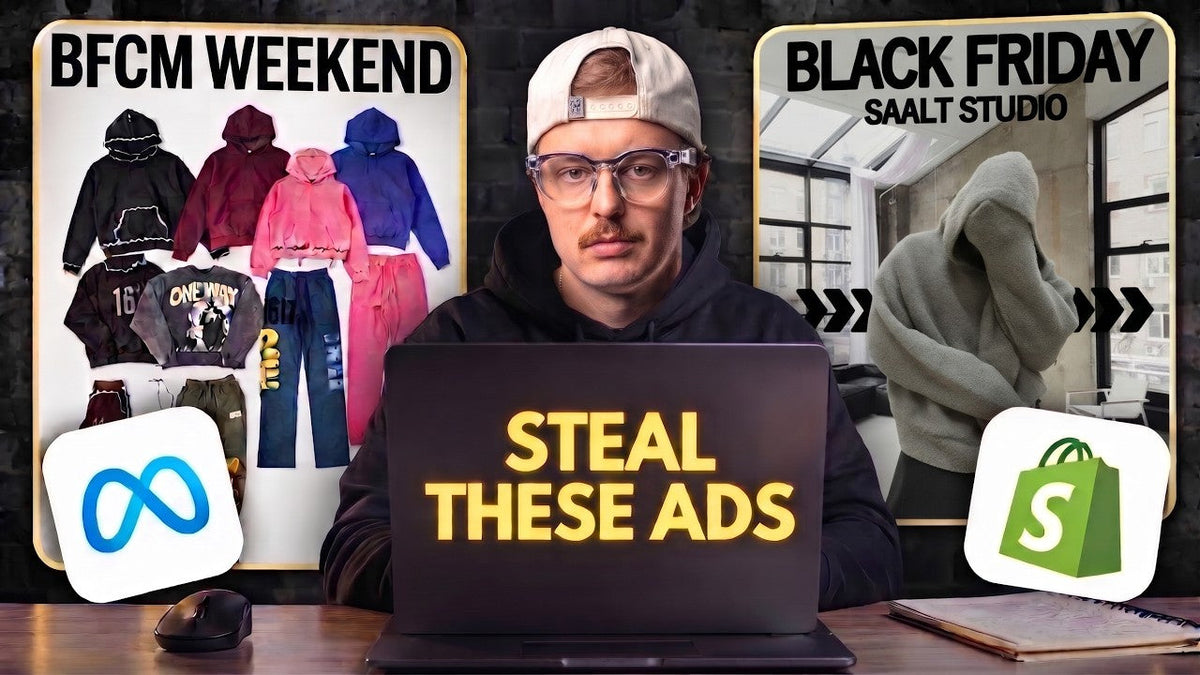
Black Friday is one of the biggest sales opportunities of the year for clothing brands. But when every brand is running discounts, simply increasing your percentage off may not be enough to stand out.
The brands that win attention take a different approach. They make their offers easy to understand, use creative that speaks to specific buyers, show real proof, and give shoppers new reasons to buy throughout the sale.
To understand what works, we analyzed 92 ad creatives from nine clothing brands, including 56 static ads and 36 videos. Drawing from these examples and experience working with more than 300 clothing brands over the past 12 months, we've identified 18 Black Friday ad strategies you can adapt for your next major promotion.
These strategies cover five key areas: the offer, trust, scale, the sale weekend, and buyer psychology.
Whether you're preparing for Black Friday Cyber Monday (BFCM) or planning your next seasonal sale, these 18 advertising plays will help you build a more effective creative strategy.
Table of Contents
-
The Offer: Make Your Discount Impossible to Miss
-
The Trust: Give Shoppers a Reason to Believe
-
The Scale: Get More From Your Winning Creatives
-
The Weekend: Keep Your Campaign Fresh
-
The Brain: Turn Attention Into Purchases
-
Three Guardrails for Black Friday Advertising
-
Your Black Friday Creative Checklist
-
How to Build a Better Black Friday Ad Strategy
The Offer — Make Your Black Friday Discount Impossible to Miss
During Black Friday, your offer is often the first thing shoppers notice. Your ads need to communicate the deal quickly, clearly, and without making people work to understand it.
Here are the first five advertising plays to test.

1. Lead With One Big Number
One of the simplest Black Friday ad strategies is to make your main discount the focal point.
Think bold typography, high contrast, and a large percentage that shoppers can understand in less than a second.
For example:
-
50% OFF
-
UP TO 60% OFF
-
BUY 2, GET 2 FREE
Brands such as Gymshark and Princess Polly use direct offer-led creative to communicate the promotion without unnecessary explanation. Hollow Socks is another brand highlighted in our creative review for its straightforward promotional ads.
The goal is to remove friction. When someone scrolls past your ad, they should immediately understand what you're offering.
How to use this for your clothing brand:
Start with one static ad that features your strongest Black Friday offer. Make the discount the main visual element, then support it with a product image and a clear call to action.
Avoid filling the design with too many messages. Your primary offer should be the first thing people see.
This is especially useful when you have limited time to prepare your Black Friday campaign.

2. Let the Price Tag Sell
Sometimes, showing the actual price is more persuasive than showing the discount percentage.
Consider the difference between these two messages:
-
"40% OFF"
-
"Was $65. Now $39."
The percentage communicates the size of the discount. The price comparison makes the savings more tangible.
This approach can work particularly well for clothing brands with premium products and higher price points. A shopper may hesitate at the original price, but a clear sale price can make the purchase feel more accessible.
Brands such as Princess Polly, Gymshark, and Represent were among the examples discussed in the creative breakdown.
How to use this for your clothing brand:
Choose a few best-selling products and create ads that show the original price alongside the Black Friday price.
For example:
Original price: $80
Black Friday price: $48
The exact savings should match your actual offer. Make sure your original price is accurate and that the promotion is available under the terms stated in the ad.
This approach is also well suited to product catalog ads, where shoppers can browse individual items and see their prices.

3. Turn the Discount Code Into a Game
A discount code doesn't always have to be presented as plain text.
You can make it part of the creative by introducing a simple interaction or curiosity hook.
For example, one Princess Polly ad challenged viewers to identify a hidden discount code. White Fox used a more direct approach, displaying its Black Friday code prominently.
Both approaches can work, but they serve different purposes.
A visible code prioritizes convenience. A hidden code adds a small challenge that may encourage people to stop scrolling and pay attention.
How to use this for your clothing brand:
Try a simple creative concept such as:
-
"Find the code. Unlock your deal."
-
"Your Black Friday discount is hiding in plain sight."
-
"Spot the code before you shop."
Keep the challenge easy enough that shoppers can solve it quickly. The goal is to create curiosity, not frustration.
Make sure the discount code is valid, easy to use, and clearly explained when customers reach your store.

4. Stack the Offer
A single discount can be compelling. Combining two benefits can make the offer feel even more valuable.
For example:
-
"Up to 60% off + an extra 20% off."
-
"Buy two, get two free."
-
"Save on selected styles, plus free shipping."
Hollow Socks and Gymshark were among the brands featured in examples of stacked or reframed offers.
The key is to communicate the combined value without making the promotion confusing.
How to use this for your clothing brand:
Look at the incentives you can genuinely support. Depending on your margins and fulfillment costs, you might combine a product discount with a bundle offer or a shipping incentive.
For example, instead of promoting only "20% off," you could test "20% off + free shipping over $100," provided the economics work.
Before launching, calculate the total discount customers can receive and confirm that the offer applies correctly at checkout. If discounts cannot be combined, state that clearly.

5. Answer the Objection in the Ad
Sometimes shoppers like a product but still have a reason not to buy it.
They might question the price, material, fit, durability, comfort, or value.
Your ad can address that concern before it becomes a reason to leave.
For example, Hollow Socks used creative that explained the materials and construction behind its products. Instead of relying on the discount alone, the ad gave shoppers more context about why the product was worth considering.
This is an important lesson for clothing brands selling premium apparel: the offer gets attention, but the reason to believe helps justify the purchase.
How to use this for your clothing brand:
Identify the three questions customers ask most often before buying.
Examples include:
-
"Is this hoodie worth the price?"
-
"Will these leggings hold their shape?"
-
"Is this shirt comfortable enough to wear all day?"
-
"How does this fabric compare with cheaper alternatives?"
Then create one ad for each objection.
Show the product, explain the relevant feature, and support the claim with evidence where possible. If customers consistently praise the fit or fabric in reviews, use those specific comments with permission.
Don't assume a discount will overcome every concern. Sometimes, shoppers need more information before they're ready to buy.

The Trust — Give Shoppers a Reason to Believe
Once shoppers notice your offer, they need to feel confident about buying from your brand.
These next four plays focus on proof, relevance, and messaging that feels natural to the people you're trying to reach.

6. Borrow a Native Interface
One way to make your ads feel more familiar is to present your message in a format people already recognize.
The creative examples included ads designed to resemble:
-
Weather apps
-
Smartphone notes
-
Incoming calls
-
Nutrition labels
-
Social media comments and replies
Hollow Socks used a weather-inspired concept to connect its products with cold-weather activities. Other examples borrowed familiar interface styles to present promotional messages in a less conventional way.
The reason this can work is simple: the format creates a different visual pattern from the usual product image and discount banner.
How to use this for your clothing brand:
Match the interface to the product and its intended audience.
A running apparel brand might use a workout log. An outdoor clothing brand might use a weather forecast. A streetwear brand might use a comment thread discussing a new drop.
Keep the message recognizable and easy to read. Avoid copying an interface so closely that the ad becomes deceptive or appears to be an actual notification from another service.
The creative should still make it clear which brand is advertising and what the customer can buy.

7. Let the Proof Do the Talking
Customers are often more persuaded by evidence than by broad promotional claims.
Instead of simply saying that your products are comfortable, durable, or popular, show shoppers why they should believe you.
In the ad examples reviewed, Hollow Socks used several types of proof, including customer testimonials, user-generated content (UGC), product claims, and footage of people using the products in outdoor conditions.
These approaches give shoppers a more concrete picture of the product experience.
How to use this for your clothing brand:
Build a collection of proof-based creative assets, such as:
-
Customer reviews that mention a specific benefit
-
Try-on videos showing the fit from different angles
-
Customer photos featuring the product in everyday settings
-
Demonstrations of fabric texture, stretch, or construction
-
Verified bestseller information, when available
For example, a clothing brand could turn a review about a hoodie staying comfortable throughout a cold day into a short video featuring the garment in use.
Use genuine reviews and accurate product claims. If a testimonial describes one customer's experience, don't present it as a guaranteed outcome for everyone.
You don't need every ad to look highly produced. Authentic product demonstrations and credible customer feedback can provide useful variety in your creative mix.

8. Lock the Template, Swap the People
You don't need to reinvent your ad design for every audience.
If a creative concept works, keep its core structure and change the people, styling, or product presentation to speak to different customer groups.
Gymshark provides a useful example. The reviewed creatives maintained a consistent headline, visual layout, and promotional code while featuring different athletes and physiques.
The result is a recognizable campaign with multiple variations.
How to use this for your clothing brand:
Start with one proven ad template. Keep the headline, offer, typography, and overall composition consistent.
Then create variations featuring different models, body types, outfits, or use cases.
For example, an activewear brand might feature:
-
A customer wearing the product for strength training
-
Another wearing it for a casual walk
-
A third styling it for everyday errands
-
A fourth demonstrating the fit and stretch
This gives you a structured way to test creative variations without redesigning every asset from scratch.
Make sure each version represents your actual customer base and product use cases. The goal is to help more shoppers see how your products fit their lives.

9. Localize the Winner
If your clothing brand advertises in multiple countries, you don't always need to develop a completely new campaign for each market.
Sometimes, the better approach is to preserve the winning creative concept and adapt it to the local audience.
The reviewed examples included brands such as ICON and Gymshark running versions of promotional creative in different languages, including Dutch, German, and French.
The central offer and visual approach remained similar while the language changed.
How to use this for your clothing brand:
If you already have a creative that works in one market, test localized versions before investing in entirely new concepts.
Adapt the details that matter:
-
Translate the headline and offer accurately
-
Use the local currency
-
Check local discount terminology
-
Confirm shipping timelines and delivery expectations
-
Make sure the landing page matches the ad's language
Don't translate the text and assume the campaign is ready. A localized ad should lead to a shopping experience that supports the same offer and customer expectations.
This approach helps you reuse creative assets while making the campaign more relevant to shoppers in each market.

The Scale — Get More From Your Winning Creatives
The next set of plays focuses on creative testing and campaign efficiency.
Instead of producing dozens of unrelated ads, you can build on what already works and isolate the variables that matter most.

10. Test Only the Hook
When an ad underperforms, it can be tempting to change everything at once.
But if you change the footage, offer, headline, and format together, it becomes difficult to understand which change affected the result.
A more structured approach is to keep the core creative consistent and test different opening hooks.
For example, the reviewed ICON jeans creatives used similar footage with different opening captions, including messaging around discovering the perfect fit.
The visual content stayed consistent while the initial message changed.
How to use this for your clothing brand:
Create three versions of the same video with different opening lines.
For a denim brand, you might test:
-
"Finally, jeans that fit the way you want."
-
"Meet your new everyday denim."
-
"Find your next favorite pair of jeans."
These hooks address different motivations: fit, versatility, and discovery.
Keep the rest of the creative as consistent as possible so you can better understand which message attracts attention and drives results.
Don't judge a hook by clicks alone. Review the available data for watch time, click-through rate, add-to-cart activity, purchases, and acquisition cost.
The best hook is the one that contributes to profitable sales, not simply the one that generates the most attention.

11. Escalate Across the Weekend
Black Friday and Cyber Monday campaigns run over several days, but that doesn't mean you should show the same message throughout the entire promotion.
White Fox provides an example of a campaign that moved between different promotional concepts, including a percentage discount, a giveaway, and a flash sale.
Each stage gave shoppers a different reason to pay attention.
How to use this for your clothing brand:
Build a campaign sequence before the sale begins.
For example:
-
Black Friday: Launch your main discount.
-
Saturday: Highlight best sellers or a relevant bundle.
-
Sunday: Introduce a new product angle or a valid additional incentive.
-
Cyber Monday: Emphasize the final offer or genuine closing deadline.
You don't have to increase the discount every day. You can introduce different products, customer benefits, or promotional mechanics while keeping the main campaign consistent.
Plan the sequence around your margins, inventory, and fulfillment capacity. Every new offer should have a clear purpose.

12. Go Big With Fake Out-of-Home Creative
Traditional out-of-home advertising uses physical placements such as billboards, transit ads, and large public displays.
Fake out-of-home (FOOH) creative borrows that visual language for digital advertising, often using computer-generated imagery (CGI) to show an exaggerated brand installation in a recognizable location.
One example from the creative review featured an oversized White Fox hoodie near Sydney Harbour and London's Tower Bridge.
The concept was designed to be visually surprising and capture attention in a crowded feed.
How to use this for your clothing brand:
Think about a recognizable location, an oversized product, or a visual scenario that would make someone stop scrolling.
For example, a sneaker brand might create a clearly labeled CGI concept featuring an enormous sneaker in a city square.
A streetwear brand might imagine an oversized hoodie installation in a familiar urban setting.
The idea doesn't need to be physically produced, but the creative should not mislead viewers into believing a fabricated event actually happened. Use appropriate disclosures when necessary, especially if the imagery could reasonably be mistaken for real footage.
The aim is to create a memorable visual that supports the brand and its offer.

13. Run One Offer in Every Format
Different people respond to different types of creative.
Some prefer polished product imagery. Others engage with founder-led videos, customer reviews, try-on clips, or shopping hauls.
You can reach these different preferences without creating a different promotion for every format.
How to use this for your clothing brand:
Choose one core Black Friday offer and adapt it into several creative formats:
-
A static graphic featuring the main discount
-
A product carousel highlighting best sellers
-
A founder-led video explaining the offer
-
A customer try-on video showing fit and styling
-
A UGC-style shopping haul
-
A product demonstration showing key features
Keep the core offer and discount code consistent across the campaign.
This allows you to test different ways of communicating the same deal instead of confusing customers with too many competing promotions.
It also gives you more opportunities to reuse existing product photography and video assets.
The Weekend — Keep Your Campaign Fresh Without Wasting Spend
Once your sale is live, your job isn't finished.
You need to keep the campaign relevant, manage urgency honestly, and protect the advertising that already works.

14. Make Urgency Feel Human
Urgency can encourage shoppers to act, but it needs to be believable.
A countdown timer that resets every time someone visits the page can undermine trust. So can a "last chance" message that remains active long after the supposed deadline.
The better approach is to connect urgency to a real reason to buy now.
How to use this for your clothing brand:
Use clear messages such as:
-
"Black Friday offer ends tonight."
-
"Final day to shop the sale."
-
"Order by [date] for the stated delivery cutoff."
-
"Limited sizes remain in selected styles."
Only use these claims when they reflect the actual promotion, inventory, or shipping schedule.
If the sale ends at midnight, make sure the landing page and checkout reflect the same deadline. If certain sizes sell out, update your product availability rather than relying on a generic scarcity message.
A simple, honest reminder can be more effective for building long-term customer trust than an exaggerated countdown.

15. Keep Evergreen Ads Live
Your Black Friday campaigns should not automatically replace every other campaign in your advertising account.
If you have evergreen ads that consistently generate profitable sales, turning them off during a promotion can disrupt a source of revenue that is already working.
The transcript recommends keeping seasonal sale campaigns separate from evergreen campaigns so each can be managed according to its purpose.
How to use this for your clothing brand:
Before Black Friday, identify the ads that have been generating profitable results outside promotional periods.
Keep those campaigns active when their economics support it, and build a separate campaign structure for your Black Friday creative.
Monitor performance across both groups. Advertising costs can rise during major shopping events, so don't assume that every evergreen ad will remain profitable at its usual level.
Also, avoid making unnecessary changes to proven campaigns simply because a seasonal sale is underway.
After Cyber Monday, review the results and return to your strongest evergreen creative instead of rebuilding your entire advertising strategy from scratch.
The objective is to capture seasonal demand without losing the foundation of your year-round acquisition strategy.

16. Put the Sale on Your Best Content
You may already have ads that perform well throughout the year.
Rather than starting from zero, you can adapt those creatives for Black Friday by adding the relevant offer.
This is one of the most straightforward ways to build a seasonal creative variation.
How to use this for your clothing brand:
Start with an ad that has already demonstrated strong results.
Preserve the product imagery, footage, and core message. Then add a clear Black Friday headline, promotional badge, or discount overlay.
For example, a successful video demonstrating the fit of your best-selling leggings could be adapted with a simple opening line:
"Black Friday: Up to 40% off."
Keep the underlying creative as consistent as possible so the main change is the offer.
Before launching, verify that the featured products are included in the promotion and that the landing page displays the same discount.
This method lets you build on existing creative assets while making the campaign timely and relevant.

The Brain — Give Shoppers a Better Reason to Buy
Discounts aren't the only reason customers make purchases.
Some shoppers want a new product, a gift, a particular color, or a premium buying experience. Others need more confidence about what happens after they click your ad.
These final two plays help you address those motivations.
17. Give Full-Price Shoppers a Reason
Not every customer is looking for the biggest possible discount.
Some want a new release. Others are shopping for gifts or are willing to pay full price for something they genuinely want.
Your Black Friday campaign can speak to those customers without discounting every product.
Two examples from the creative review were a new colorway released during a promotion and Princess Polly's use of gift cards as a product offering.
How to use this for your clothing brand:
Consider adding one of these alternatives to your sale strategy:
Launch a new colorway. Give existing customers a reason to return by introducing a new version of a popular product.
Promote gift cards. Position them as an option for shoppers who want to give clothing but aren't sure about the recipient's size, fit, or preferred style.
Feature products outside the main discount. If a product is new or excluded from the promotion, communicate that clearly and give shoppers a reason to consider it.
Gift cards can also bring revenue into the business before the recipient redeems them, although future redemption obligations, fees, and applicable accounting rules still need to be considered.
The key is to offer more than one reason to shop. A broader campaign can serve customers who aren't motivated by discounts alone.

18. Design What Happens After the Click
Your ad is only one part of the buying experience.
Even a compelling Black Friday promotion can lose sales if the landing page is confusing, the discount doesn't apply, shipping information is unclear, or the brand experience feels inconsistent.
The transcript highlighted a premium-looking Fear of God sale creative that communicated a 50% discount while maintaining a clean editorial presentation. The message was direct without relying on excessive promotional badges.
This illustrates an important point: a strong discount doesn't require your brand to look cheap.
How to use this for your clothing brand:
Make sure your landing page continues the same message and visual style as the ad.
Before the campaign launches, check the following:
-
The advertised discount matches the products and checkout rules.
-
Product prices and promotional terms are clear.
-
Discount codes work correctly.
-
Exclusions are easy to find.
-
Shipping costs and delivery cutoffs are accurate.
-
Product images, sizing information, and stock availability are up to date.
-
The mobile shopping experience is easy to navigate.
-
The checkout process works as expected.
If your brand has a premium position, maintain that presentation across your ads, product pages, and promotional landing pages.
Avoid filling every section with discount badges or aggressive messaging. Make the offer clear while preserving the experience customers expect from your brand.

Three Guardrails for Black Friday Advertising
Before launching your campaign, keep these three principles in mind.
1. Use Real Proof
Only use genuine testimonials, accurate product claims, and verifiable bestseller statements.
If you're showing customer content, obtain the necessary permission. If you're making a claim about a product's performance, ensure you have evidence to support it.
2. Make Giveaway Rules Clear
If your promotion includes a giveaway, clearly communicate the applicable terms and eligibility requirements.
Review the relevant laws and platform policies for the markets where you advertise. When necessary, consult a qualified legal professional before launching.
3. Put Exclusions in Plain Sight
Don't hide restrictions that materially affect the offer.
If selected products are excluded, a minimum spend applies, or discounts cannot be combined, communicate those conditions clearly.
Your ads, product pages, and checkout should all reflect the same promotion.
Clear terms help set expectations and reduce avoidable customer frustration.
Your Black Friday Creative Checklist
You don't need to produce dozens of unrelated ads to prepare for Black Friday. Start with a focused set of creative assets that covers the most important buyer motivations.
Use this checklist to organize your production plan.
-
One clear offer-led static ad featuring your main discount.
-
Three objection-focused ads answering common questions about price, fit, quality, or product benefits.
-
Five hook variations that test different opening messages.
-
Evergreen winners keep active when they remain profitable.
-
One stacked or reframed offer that adds value without confusing shoppers.
-
One reusable creative template with four to five model or product variations.
-
A fresh reason to return every 48 hours during the sale, such as a new product angle, gift-card promotion, or legitimate offer update.
-
A mobile landing-page review covering pricing, discount codes, shipping, exclusions, and checkout.
-
A clear campaign schedule for Black Friday through Cyber Monday.
-
A post-sale plan for returning to evergreen creative and reviewing campaign results.
This is a starting framework, not a requirement to launch every asset at once. Prioritize the plays that fit your brand, budget, inventory, and customer behavior.

How to Build a Better Black Friday Ad Strategy
The biggest lesson from these 18 Black Friday advertising plays is that creative variety matters.
A larger discount can attract attention, but the strongest campaigns give shoppers several reasons to act. They communicate the offer clearly, answer objections, provide proof, test different hooks, and keep the buying experience consistent from the ad to checkout.
You don't need to copy every competitor or create an entirely new campaign from scratch.
Instead, start with your strongest offer and existing creative. Build variations around the messages your customers care about, then use the results to guide your next decisions.
Need Help Planning Your Next Sale?
If you're preparing for Black Friday, Cyber Monday, or another major promotion, a second set of eyes can help you identify gaps in your creative, offer, messaging, and customer journey.
Book a free strategy session to review your brand, identify opportunities, and build a clearer plan for growing your online store.
Schedule Your Free Strategy Session →
The goal isn't simply to run more ads. It's to understand what your brand needs most and put your time and budget toward the changes that matter.



Share:
How Premium Brands Run Black Friday Without Looking Cheap