

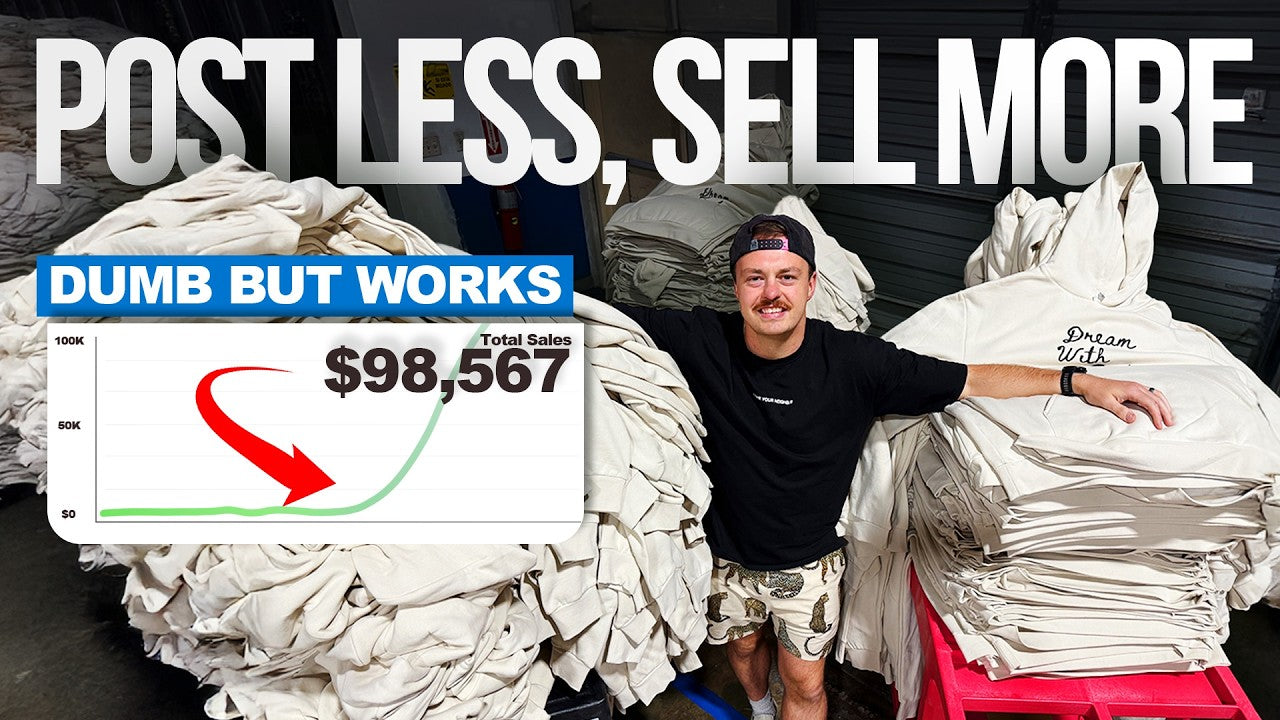
Most clothing brands are exhausting themselves for the wrong reasons.
They are posting relentlessly—three times a day, every day—chasing views, chasing trends, chasing algorithms. And yet, despite the effort, the results barely move. Engagement stays flat. Sales stay inconsistent. Growth feels impossible.
At the same time, a smaller group of brands is quietly doing the opposite.
They are posting less.
They are working smarter.
And they are scaling faster.
Some of these brands are crossing $50K, $100K, and even six figures per month—not because they cracked some secret algorithm, but because they implemented a simple, repeatable system.
This article breaks down that system in full.
It is not about hacks.
It is not about trends.
And it is definitely not about posting more content.
It is about structure, clarity, and strategic leverage—the low-effort strategy that is currently blowing up clothing brands.
Two Paths Every Clothing Brand Is On

Right now, your brand is on one of two paths.
Path One: High Effort, Low Return
On this path, brands believe volume is the solution. They post constantly. They jump on trending audio. They copy viral dances. They hope that more content equals more reach.
Sometimes they get views.
Rarely do they get buyers.
This path leads to burnout, inconsistency, and frustration. The audience grows slowly—if at all—and the people who do follow rarely convert into customers.
Path Two: System-Driven Growth
On the second path, brands post less content but generate more revenue.
They operate with a system.
They understand their audience deeply.
They create content intentionally.
They capture attention and convert it into owned data.
This path is quieter, more strategic, and far more profitable.
The difference between brands stuck at $5K per month and brands scaling to $100K per month is not talent, luck, or budget.
It is one decision.
One shift.
One process.
And most brands have never heard of it—let alone implemented it.
Why “More Content” Is Not the Answer

After working with hundreds of clothing brands over the last year, a clear pattern has emerged:
Posting more does not automatically lead to more growth.
In fact, many brands posting less are performing just as well—or better—than brands posting multiple times per day.
This directly contradicts much of the conventional advice circulating online.
Trending audio does not build a real brand.
Dance trends do not build a loyal customer base.
Views alone do not equal sales.
These tactics may inflate vanity metrics, but they often attract people who will never buy your clothing.
The original reason volume was pushed so heavily was simple: repetition builds skill. No one becomes great without practice. But repetition without direction eventually becomes noise.
What brands are missing is not effort.
It is a framework.
The Missing Piece: A Proven Content Framework

Think of content creation like time travel.
In Back to the Future, time travel wasn’t possible until one missing component was invented—the flux capacitor. Once that piece was in place, everything worked.
Content creation is no different.
Most brands already have talent, passion, and effort. What they lack is the one component that makes everything work together:
A proven framework.
Without it, content feels random.
With it, content compounds.
This framework starts long before posting a single video.
It starts with understanding your audience at a level most brands avoid.
The Core Problem: Brands Don’t Know How to Speak to Their Audience

Many brands believe they know their audience.
They can name demographics.
They can define age ranges.
They can describe style preferences.
And yet, they still struggle to convert attention into sales.
The reason is simple: they do not know how to speak directly to their audience.
Every scalable brand shares one trait: They communicate with clarity, relevance, and emotional precision.
Brands that fail to scale avoid this work. And the things you avoid are often the things controlling your growth.
Understanding your audience is not a surface-level exercise. It requires structure, depth, and intentional thinking.
This is where the three foundational documents come in.
The Three Documents Every Clothing Brand Needs

Every successful clothing brand—whether they realize it or not—operates with answers to three core questions.
Putting these answers on paper changes everything.
1. The Struggling Avatar
This document defines the problem your customer is experiencing before they find your brand.
Problems can be functional:
-
Clothes that chafe
-
Poor fit
-
Heavy fabrics
-
Lack of durability
Or emotional:
-
Lack of confidence
-
Desire to fit in
-
Feeling uncomfortable in one’s body
-
Wanting to express identity
The key insight is this:
You already know your customer—you just haven’t externalized it.
Until the struggling avatar is written clearly, your messaging will remain vague.
2. The Unique Solution
The unique solution is not always the product itself.
Sometimes it is the outcome the product provides:
-
Confidence
-
Comfort
-
Reduced stress
-
Belonging
-
Identity reinforcement
Two hoodies can look identical.
But if one represents safety, comfort, or emotional relief, it wins.
This document forces you to articulate why your brand exists beyond aesthetics.
3. The Future Pace Hero
This is the transformation.
What does life look like after the customer solves their problem with your brand?
More confidence?
Better social experiences?
A stronger sense of self?
Brands that only sell designs cap their growth quickly. Brands that sell transformation scale far beyond aesthetics.
Why Design-Only Brands Plateau
Great design matters—but design alone limits your ceiling.
Design-driven brands typically tap into a very small segment of the population. They might reach $5K–$20K per month, but growth stalls.
When you anchor your brand to a problem instead of just a look, your audience expands dramatically.
More people relate to problems than aesthetics.
This is the difference between a niche hobby brand and a scalable business.
Strategy vs. Tactics: A Critical Distinction
Most founders confuse tactics with strategy.
Strategy is the elimination of unknowns between where you are and where you want to go.
For clothing brands, the goal is simple:
-
Engagement
-
Sales
Everything else supports those outcomes.
A proper strategy includes four stages:
-
Research
-
Pattern recognition
-
Content categorization
-
Capitalization
Without this structure, content becomes guesswork.
Research: Learning From What Already Works

Start by identifying seven brands:
-
Five within your niche
-
Two completely outside of it
Study their highest-performing content.
An outlier video is one that performs at least 5x better than the brand’s follower count would suggest.
Save the top five videos from each brand. You should end up with 35 examples.
This is not inspiration.
This is data collection.
Pattern Recognition: Finding the Signals
Look for similarities across those videos:
-
Visual hooks
-
Audio hooks
-
Camera angles
-
Presence of people
-
Framing and pacing
The first three seconds matter more than everything else.
Hooks are not accidental.
They are engineered.
The Four Content Categories That Drive Growth

Once patterns are identified, content must fall into clear categories.
1. Thought Reversal
Challenge assumptions your audience already holds.
Example:
Christian clothing is boring.
When you disrupt beliefs, attention follows.
2. Connection Content
This is storytelling.
Founders often realize something powerful here:
They are their target customer.
Your story creates trust.
Trust creates loyalty.
Loyalty creates sales.
3. “What To Do” Content
Educational, actionable guidance aligned with your audience’s values.
This positions your brand as a leader, not just a seller.
4. Product Placement (Done Correctly)
Most brands rely solely on this category—and it is why they struggle.
Product-only content forces users to:
-
Visit profile
-
Click website
-
Browse
-
Decide
That is too much friction.
The Low-Effort Conversion Lever: Owned Data
This is where the strategy becomes truly powerful.
Instead of sending traffic to a website, successful brands capture owned data.
Tools like automation platforms allow users to comment on a keyword and receive a direct message, offer, or resource.
This:
-
Increases engagement
-
Builds email lists
-
Creates long-term leverage
-
Reduces dependence on algorithms
Owned data is the difference between brands that survive and brands that scale.
Nurturing Converts Attention Into Revenue

Capturing an email is not enough.
A structured welcome sequence builds:
-
Trust
-
Familiarity
-
Desire
This relationship compounds over time.
When brands master content and owned data together, ads become fuel—not a crutch.
Why This Strategy Works
This approach works because it aligns effort with leverage.
Less posting.
More intention.
Clear messaging.
Direct conversion paths.
It removes randomness and replaces it with repeatability.
And that is what allows clothing brands to grow without burning out.
Final Thoughts
The brands winning right now are not working harder.
They are working with clarity.
They know who they serve.
They know what problem they solve.
They know how to communicate transformation.
And they use systems to convert attention into ownership.
This is the low-effort strategy that is blowing up clothing brands.
And once you see it, you cannot unsee it.
How to Implement This Without Guessing or Burning Time

At this point, the strategy should be clear.
Posting more is not the lever.
Trends are not the lever.
Even great design, by itself, is not the lever.
The real leverage comes from building the right foundation—clear audience definition, intentional content categories, owned data capture, and a system that turns attention into predictable sales.
Where most brands get stuck is not understanding what to do, but trying to implement all of this alone while still running day-to-day operations. Small missteps compound quickly, and months get wasted chasing tactics instead of building momentum.
If you want help applying this exact framework to your brand—without trial and error—you can book a free strategy session.
During this call, we will:
-
Identify what is currently limiting your growth
-
Clarify your audience, messaging, and positioning
-
Diagnose why your content is not converting
-
Map a realistic path to consistent monthly revenue
This is not a sales call. It is a working session designed to give you clarity and direction, whether or not we move forward together.
Spots are limited.
Schedule your strategy session here:
https://www.optimizedstoreowner.com/schedule-strategy-session




Share:
How I Made This Clothing Brand A Million Dollars In 30 Days
One Shopify Fix That’s Holding Your Clothing Brand Back