

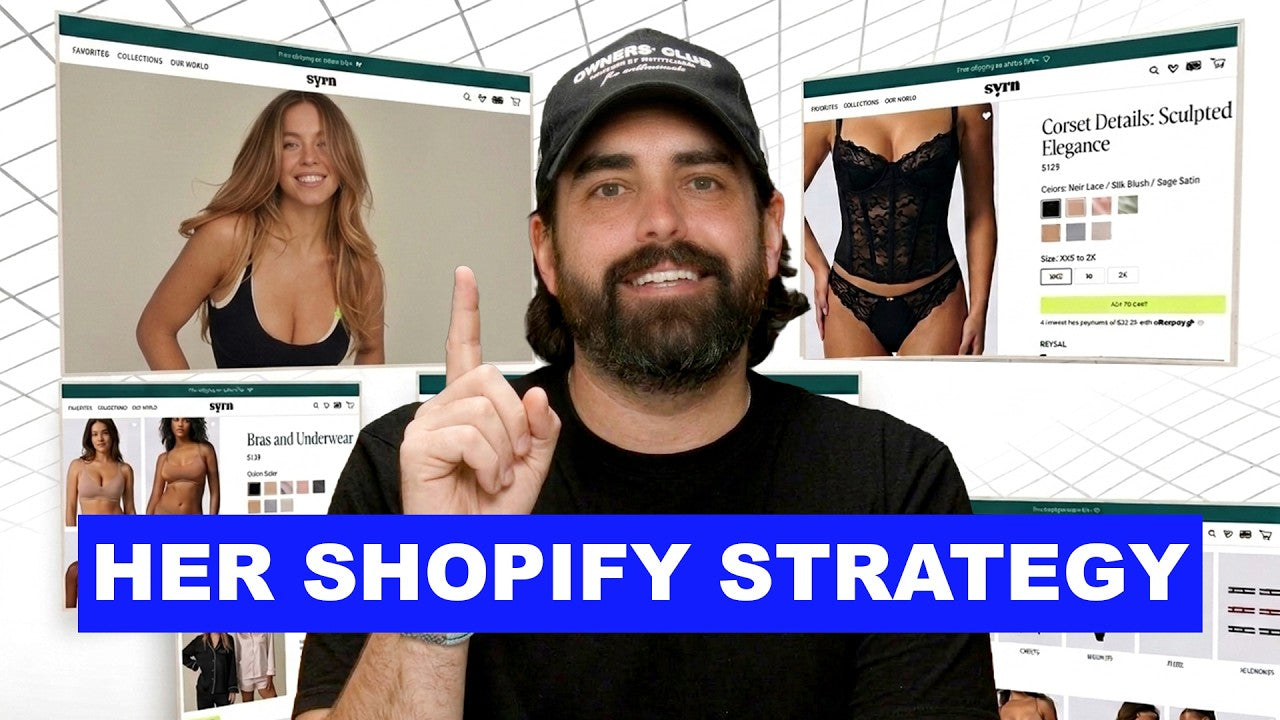
Celebrity-backed brands usually get attention. Very few get the eCommerce fundamentals right.
That is what makes Sydney Sweeney’s lingerie label SYRN worth studying. The brand did not launch as a random merch play or a fame-fueled storefront. It launched with a distinct identity system, a conversion-oriented product-page structure, and a clear emphasis on owned audience capture before and during drops. Public reporting around the launch highlighted four style “worlds,” a broad size range, and a fast initial sellout—signals that the brand was built to convert, not just to generate press.
For Shopify founders, the real lesson is not “be famous.” It is this:
Launch around identity, remove buying friction on the PDP, and build owned demand before the drop.
This article breaks down how that works in practice—and how to execute it in Shopify with modern tooling.
Why This Launch Matters More Than Most Celebrity Brand Launches

SYRN positioned itself around self-expression rather than around a flat product catalog. On the live site and in launch coverage, the brand emphasized four identity-based collections—Seductress, Romantic, Playful, and Comfy—rather than leading with plain category architecture like “bras,” “panties,” or “sets.” That framing matters because it mirrors how shoppers actually browse apparel: through mood, identity, occasion, and aspiration.
In other words, the store merchandising was not just aesthetic. It was functional.
That is the first big lesson for brands on Shopify:
Do not just organize a store by SKU type. Organize it by how a shopper wants to feel, who they want to be, or where they plan to wear it.
Why Identity-Led Merchandising Drives Better Ecommerce Performance
One reason SYRN's launch stands out is its approach to Ecommerce Merchandising. Instead of presenting shoppers with a traditional catalog structure, the brand organized products around identities and moods. This approach helps customers navigate the store based on how they want to feel rather than forcing them to browse through dozens of product categories.
For Shopify merchants, strong Ecommerce Merchandising is not just about aesthetics. It directly impacts product discovery, engagement, and conversion rates. Brands that create emotional entry points often reduce decision fatigue and improve the overall shopping experience.
This strategy is especially effective when combined with structured data tools like Shopify Metaobjects and Shopify Metafields, which allow merchants to create reusable merchandising systems across collections, product pages, and marketing campaigns.
1. They Sold Identity, Not Just Product

Most brands launch with a catalog-first structure:
-
Bras
-
Thongs
-
Briefs
-
Lounge
-
Sets
That is easy for the merchant. It is not always persuasive for the customer.
SYRN’s four-world structure gives the shopper a faster emotional entry point. A visitor does not have to decode a large inventory from scratch. She can start with a version of herself: comfy, playful, romantic, or seductive. Public launch coverage explicitly described the brand this way, and the site still reflects that identity-led merchandising.
Shopify execution: how to build identity-led collections properly
Here is how to make this actionable inside Shopify rather than leaving it as a vague branding recommendation.
Use Shopify Metaobjects for “style worlds”
Create a Metaobject definition called Style World with fields such as:
-
Name
-
Slug
-
Mood description
-
Hero image
-
Color palette
-
Messaging angle
-
Featured collection
-
Recommended products
-
UGC quote
-
Occasion tags
Then assign each relevant product a Metafield reference to the appropriate Style World.
That gives you a reusable architecture across:
-
Collection page hero modules
-
Product page badges
-
Homepage featured worlds
-
Email segmentation
-
Search & Discovery filtering
Instead of manually rewriting copy for every SKU, you centralize the emotional positioning once and reuse it everywhere.
Pair Metaobjects with automated collections
For example:
-
style_world = comfy
-
style_world = romantic
-
drop = spring_capsule_01
This lets you create dynamic merchandising without rebuilding landing pages every time a drop happens.
Why this is better than manual collection building
If you rely on normal collections alone, your team ends up duplicating:
-
hero copy
-
card labels
-
badges
-
editorial content
-
merchandising logic
With Metaobjects and Metafields, you can update one “world” once and propagate that identity across dozens of products.
That is the difference between a store that looks branded and a store that is operationally scalable.
“Rather than opening with generic product taxonomy, SYRN merchandises around four personas: Seductress, Romantic, Playful, and Comfy.”
Before-and-after visual example:

Before
-
Bras
-
Panties
-
Lounge
-
Bodysuits

After
-
Comfy
-
Playful
-
Romantic
-
Seductress
What this proves: the brand is guiding discovery through emotion and self-concept, not through inventory structure.
2. They Turned One Launch Into Multiple Merchandising Moments

One of the smartest ideas in the transcript is that the launch was effectively structured as multiple drops, not one single “big bang” event. That tracks with launch coverage, which described the brand as rolling out four distinct worlds rather than treating the assortment as one undifferentiated release.
This matters because it creates more than a launch.
It creates:
-
more email subject lines
-
more social hooks
-
more creator seeding moments
-
more homepage refreshes
-
more retargeting angles
-
more reasons for a customer to come back
Shopify execution: build drops as a system, not as ad hoc campaigns
Use a drop-specific tag structure
Every product should carry a launch taxonomy such as:
-
drop:seductress_01
-
drop:romantic_01
-
drop:playful_01
-
drop:comfy_01
That enables:
-
automatic collection generation
-
drop-specific landing pages
-
Klaviyo segments
-
drop-specific analytics views in GA4 or Triple Whale
Use Shopify theme templates for each drop
Instead of reusing a generic collection template, create a dedicated template for each drop with:
-
unique hero
-
editorial intro
-
visual mood board
-
related products module
-
signup module
-
social proof strip
This prevents every launch page from looking like a slightly edited clone.
Build prelaunch waitlists by drop
Do not just collect a generic newsletter signup.
Collect intent by theme:
-
“Notify me when Romantic launches”
-
“Get early access to Comfy”
-
“Text me when Seductress drops”
That gives you cleaner demand signals and stronger campaign segmentation.
If you have analytics access to your own store, this is also where you can include a real benchmark such as:
-
waitlist signup rate
-
SMS opt-in rate
-
returning visitor revenue during each drop window
-
revenue per recipient by drop segment
That kind of proof point is far more persuasive than a general statement like “multiple drops build hype.”
Shopify Product Page Optimization Starts With Reducing Customer Uncertainty
Many ecommerce brands invest heavily in advertising but overlook Shopify Product Page Optimization. The reality is that product pages are where buying decisions happen. If shoppers cannot quickly understand fit, benefits, quality, or use cases, they are far more likely to abandon the purchase.
Effective Ecommerce Product Page Design focuses on reducing uncertainty through visual guidance, structured information, product education, and trust-building elements. The goal is not simply to display products. The goal is to help customers feel confident enough to buy.
When executed properly, Shopify Product Page Optimization becomes one of the most impactful forms of Shopify Conversion Rate Optimization because it addresses objections before they stop the sale.
3. Their Product Pages Reduce Friction Instead of Creating It

This is where most Shopify brands lose money.
A lot of founders think a product page exists to display photos, list materials, and add an “Add to Cart” button. But apparel PDPs need to answer uncertainty quickly, because uncertainty is what kills conversion.
From the transcript, one of the standout details was a coverage/reveal visual tool that helped shoppers understand how revealing a lingerie item might be. The broader point is sound: the page used visual decision aids to answer buyer questions before hesitation turned into abandonment.
Shopify execution: how to build friction-killing PDPs
A. Use Metafields for reusable product education
Instead of burying everything in one long description, create reusable Shopify Metafields such as:
-
coverage_level
-
support_level
-
lining_type
-
fabric_feel
-
occasion
-
fit_notes
-
model_size
-
model_measurements
-
care_summary
Then surface those in structured content blocks on the PDP.
That matters because a bra, bodysuit, or brief often shares the same education fields across many variants and styles. Metafields let you standardize product education without rewriting copy manually for every page.
B. Use Metaobjects for “fit guide cards”
Create a Metaobject called Fit Guide Card with:
-
Title
-
Icon or image
-
One-line explanation
-
Category relevance
-
Tooltip copy
Examples:
-
Lightly lined
-
Push-up
-
Balconette
-
High-rise
-
Mid-rise
-
Cheeky
-
Full coverage
Then reference the relevant cards on each product.
This is much cleaner than maintaining separate static size-guide pages that shoppers have to leave the PDP to read.
C. Use collapsible rows only for secondary content
A common mistake is hiding essential buying information behind accordions.
Primary decision drivers—fit, support, coverage, model sizing, fabric feel—should be visible above or near the fold.
Reserve collapsible rows for:
-
shipping
-
returns
-
fabric composition
-
washing instructions
D. Use variant-aware content
If a product has several colors or cuts, use variant-linked media and variant-specific Metafields so the right fit notes show when the shopper changes the option.
If not, you force the buyer to do interpretation work, and interpretation work lowers conversion.

“A visual decision tool reduces guesswork more effectively than a paragraph of descriptive copy.”
Before-and-after example:
Before
-
“Sexy lace bra”
-
Material composition
-
Size chart in popup
-
One model
-
No fit language
After
-
Coverage scale
-
Support level
-
Model measurements
-
Fit notes
-
Fabric feel descriptors
-
Occasion suggestions
What this proves: high-converting PDPs reduce ambiguity before it becomes an objection.
4. The Best Product Pages Teach, Not Just Describe
The transcript also highlights embedded education: diagrams, style explanations, silhouette breakdowns, and fit guidance kept directly on the product page.
That is a critical point.
In lingerie, shapewear, denim, swim, and activewear, the customer is often trying to answer some version of:
-
What does this actually do?
-
How will it fit?
-
How revealing is it?
-
How supportive is it?
-
What is the difference between this and the other one?
If you do not answer that immediately, the shopper either bounces or delays the decision.
Shopify execution: use content blocks like a merchandiser, not a catalog manager
Build a “How it fits” block
This can include:
-
silhouette illustration
-
rise level
-
support level
-
intended feel
-
stretch rating
-
compare-to module
Build a “Why choose this style?” block
Good for adjacent-option confusion:
-
balconette vs triangle
-
cheeky vs bikini
-
lined vs unlined
-
medium support vs high support
Build a “Wear it for” block
This lets you merchandise use case:
-
date night
-
layering
-
lounging
-
under tees
-
under low-cut tops
-
all-day comfort
This content can be driven by Metaobjects so the same structured blocks can be reused across dozens of SKUs.
5. Their Copy Sells a Premium Experience, Not Just Fabric Composition

The transcript correctly points out that storytelling on the product page matters. If your copy only says “nylon/spandex blend,” you are giving the shopper raw data, not purchase motivation.
High-converting apparel copy should do three things at once:
-
clarify utility
-
reinforce identity
-
increase perceived value
Shopify execution: where copy should work harder
Product title
Do not rely only on search-term naming.
Bad:
-
Lace Triangle Bra Black
Better:
-
Tit for Tat Triangle Bralette
SYRN’s live catalog includes playful naming and brand voice that feels more editorial than generic catalog language.
Microcopy
Do not leave defaults everywhere.
Rewrite:
-
cart empty state
-
add-to-cart confirmation
-
back-in-stock CTA
-
waitlist copy
-
related products heading
-
bundle module headline
These are tiny moments, but together they determine whether the store feels premium or templated.
Shopify execution detail
Use theme settings and locale files to replace default language globally. For richer voice by section, use theme blocks or section settings so merchandisers can update copy without touching code.
That is how you make a brand voice operational—not just aspirational.
6. Model Transparency Is a Conversion Asset, Not a Nice-to-Have
The transcript mentions product imagery that identifies the model and what size she is wearing. That is exactly the kind of detail apparel brands underestimate.
Shoppers do not just want to know the product. They want to know the frame of reference.
Shopify execution: how to do this properly
Create product media captions or a PDP block tied to Metafields such as:
-
model_name
-
model_height
-
model_bust
-
model_waist
-
model_hips
-
model_size_worn
If you use multiple models, show more than one body type and connect the right stats to the right image set.
That reduces one of the biggest unspoken objections in apparel:
“This looks good on her, but would it look right on me?”
Stronger version for larger catalogs
Use a Model Profile Metaobject and reference it from product media sets. That way, when a model appears across multiple PDPs, you only update her measurements once.
That is the kind of implementation detail that saves real team time.
“Model transparency helps customers estimate fit faster and reduces uncertainty on size selection.”
If you have real store analytics, compare:
-
conversion rate on PDPs with model measurements vs without
-
return rate on items with enhanced fit content vs basic PDP content
I would not invent a specific uplift number here unless you have first-party data. It is better to be precise and honest than to overstate.
7. They Built an Owned Audience Instead of Renting All Their Demand
This is one of the strongest strategic points in the original article and it becomes even more important in 2026.
SYRN’s site and launch coverage show a clear emphasis on direct audience capture and branded ecosystem building, including email/SMS signup and Instagram-led awareness. The brand’s Instagram presence is also already significant, with hundreds of thousands of followers, which supports the idea that social attention was being routed into owned channels and brand-controlled commerce.
Ecommerce Customer Retention Is More Valuable Than Constant Customer Acquisition
Many brands focus entirely on generating new traffic, but sustainable growth depends heavily on Ecommerce Customer Retention. SYRN's emphasis on audience capture through email and SMS demonstrates a long-term approach to customer relationships rather than relying exclusively on paid traffic.
Strong retention systems help brands increase lifetime value, encourage repeat purchases, and reduce dependence on rising advertising costs. For Shopify merchants, retention strategies may include personalized email flows, loyalty programs, replenishment campaigns, VIP offers, and post-purchase experiences.
This is where Shopify Growth Strategy extends beyond a single launch. The goal is not simply acquiring customers during a product drop. The goal is creating systems that keep customers engaged long after their first purchase.
The key principle is simple:
Attention is volatile. Owned audience is durable.
Modernize the channel mix: it is no longer just Meta ads and Google
A current commerce stack should include at least four layers:
1. Email and SMS
Still essential for:
-
early access
-
back-in-stock
-
drop alerts
-
cross-sell
-
retention
2. Social commerce
Now this should include:
-
TikTok Shop
-
Instagram Shop / Shop-enabled discovery
-
Shop app surfaces where relevant
-
creator whitelisting
3. AI-driven personalization
Merchants should now test:
-
personalized product recommendations
-
predictive sorting
-
behavior-based onsite content
-
AI-assisted quiz flows
-
replenishment or reorder prompts for repeatable categories
4. Creator-driven conversion
Not just influencer awareness.
Think:
-
creator landing pages
-
creator-specific codes
-
affiliate attribution
-
TikTok Spark Ads
-
UGC retargeting
That is the modern expansion of the original article’s audience-building point.
8. What a 2026 Shopify Growth Stack Looks Like

If you want to modernize the article, this section should replace any old “run Facebook and Google ads” framing.
Recommended stack
Onsite
-
Shopify theme with fast mobile UX
-
Search & Discovery app for merchandising logic
-
Metaobjects and Metafields for structured PDP content
-
quiz or guided selling flow if category complexity is high
-
personalized recommendation engine
CRM
-
Klaviyo or equivalent for email
-
Attentive, Postscript, or equivalent for SMS
-
segmented flows by collection, waitlist, and drop behavior
Social commerce
-
TikTok Shop where category and geography allow
-
Instagram-native shopping flows
-
creator storefront or affiliate infrastructure
Measurement
-
GA4
-
Triple Whale or Northbeam style attribution layer
-
post-purchase survey asking “How did you hear about us?”
-
holdout testing on creator or paid campaigns
Retention
-
back-in-stock flows
-
replenishment or re-engagement flows
-
review requests
-
post-purchase cross-sell
-
VIP / early-access segments
That is how you move from “brand launch” to “repeatable commerce engine.”
9. What Real Proof Looks Like in an Article Like This

You asked to add visual evidence and direct references to real performance improvements. That is the right move, but the standard needs to be high.
Here is the best way to do that without overclaiming.
Use verifiable public proof for this article
You can credibly state:
-
SYRN launched in January 2026.
-
The brand positioned itself through four style identities: Seductress, Romantic, Playful, and Comfy.
-
The assortment emphasized a broad size range from 30B to 42DDD.
-
Coverage reported that the first collection sold out quickly, within hours.
Do not fabricate conversion uplift
Unless you have backend analytics, do not claim things like:
-
“coverage sliders increased CVR by 18%”
-
“waitlists cut CAC by 23%”
-
“storytelling lifted AOV by 12%”
Instead, say:
-
“These elements are designed to reduce friction and improve purchase confidence.”
-
“This launch suggests that the site translated attention into conversion effectively.”
-
“If you want to prove impact in your own store, measure CVR, ATC rate, and return rate before and after implementation.”
That is more credible.
10. Updated Takeaways for Shopify Founders
Sydney Sweeney’s launch worked because it combined brand, merchandising, and conversion architecture.
Here is the sharper version of the lesson:
1. Organize by identity
Use Metaobjects and Metafields so persona-based collections are reusable and scalable.
2. Build product pages that answer objections visually
Use structured fields for coverage, support, fit, model measurements, and use-case education.
3. Treat copy like UX, not decoration
Product names, waitlist copy, empty-cart copy, and section labels all shape perceived brand quality.
4. Launch in chapters, not all at once
Use drops, waitlists, segmented campaigns, and refreshed landing pages.
5. Build owned demand before you need it
Email and SMS are still critical, but today’s mix also includes TikTok Shop, creator programs, AI personalization, and social commerce integrations.
How Shopify Store Optimization Turns Traffic Into Revenue
Celebrity attention may create awareness, but long-term success depends on effective Shopify Store Optimization. Every element of the customer journey, from collection pages and navigation to product education and checkout flow, contributes to conversion performance.
Brands that invest in Shopify Conversion Rate Optimization and broader Ecommerce Conversion Optimization efforts often see greater returns from their existing traffic because they focus on improving the shopping experience rather than simply increasing visitor volume.
For apparel brands looking to scale, combining strong merchandising, optimized product pages, audience retention systems, and thoughtful store design creates a more reliable path to growth than relying solely on advertising.
For businesses seeking professional support, services such as Ecommerce Website Design Texas, Shopify Website Design Texas, and Clothing Brand Marketing Texas can help create the infrastructure needed to support long-term ecommerce growth.
Final Word

The reason this launch deserves attention is not simply that Sydney Sweeney is famous. It is that SYRN appears to have been built with modern commerce logic: identity-led merchandising, low-friction PDPs, and owned audience infrastructure from day one. Public reporting also noted that the brand launched with four differentiated worlds, inclusive sizing, and a rapid initial sellout—all signs of a launch engineered for conversion, not just visibility.
That is the real takeaway for Shopify brands:
You do not need a celebrity founder. You need a better system.
And if you want help building that system—from merchandising architecture to PDP strategy to retention flows—book a strategy session here:



Share:
Rebuilding REPRESENT’S Product Page from Scratch
Instagram's NEW Algorithm for Clothing Brands 2026